UAE Corporate Tax Penalties: The Complete 2026 List
All fourteen corporate tax penalties from Cabinet Decision 75 of 2023. Late filing doubles at month thirteen, late payment is 14% a year, and the AED 10,000 registration penalty is waivable.
The short answer. UAE corporate tax penalties live in Cabinet Decision No. 75 of 2023, amended by Cabinet Decision No. 10 of 2024. They are a separate schedule from the value added tax and excise penalties, which sit in Cabinet Decision No. 40 of 2017. Late filing costs AED 500 a month for the first twelve months and AED 1,000 a month after that. Late payment costs 14% a year. Late registration is AED 10,000, and it is waivable.
The decision that governs this, and the one that does not
This trips up even careful advisers, because two penalty schedules run alongside each other and both were in the news in 2026.
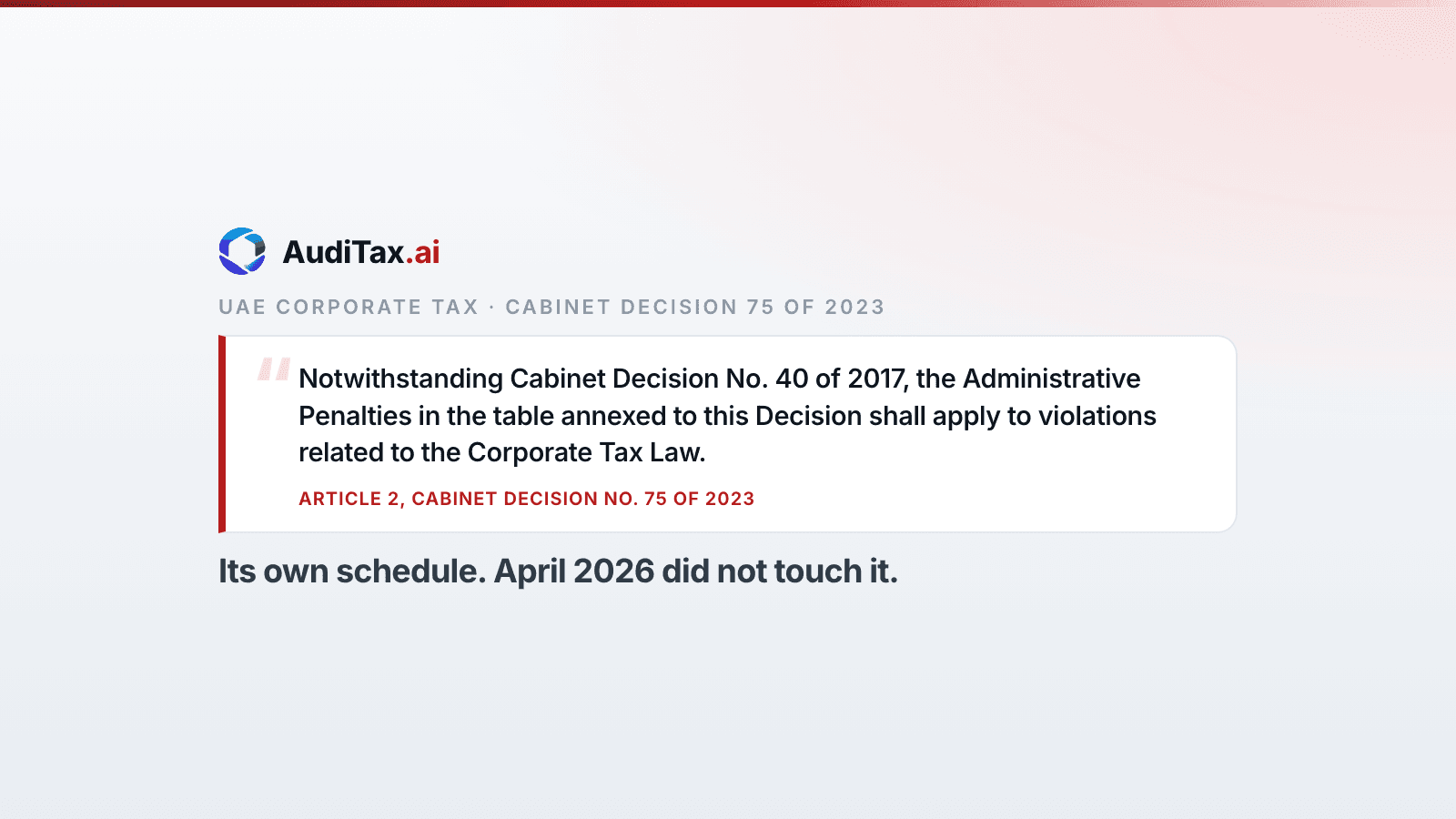
Corporate tax penalties are in Cabinet Decision No. 75 of 2023, issued 10 July 2023 and effective 1 August 2023, as amended by Cabinet Decision No. 10 of 2024, issued 22 February 2024 and effective 1 March 2024. Article 2 is explicit: notwithstanding Cabinet Decision No. 40 of 2017, the penalties in the table annexed to Decision 75 apply to violations related to the application of the Corporate Tax Law.
Value added tax and excise penalties are in Cabinet Decision No. 40 of 2017, amended most recently by Cabinet Decision No. 129 of 2025, which was issued on 9 October 2025 and took effect on 14 April 2026. That consolidated decision defines "Tax Law" as the Excise Tax Law and the Value Added Tax Law. It does not mention corporate tax.
So the April 2026 reform that reduced value added tax penalties did not change the corporate tax schedule. If you have seen a 2026 article implying one set of penalties now covers all three taxes, it is wrong, and the error is easy to make because the headline rate for late payment happens to be the same in both.
Every corporate tax penalty, in full
Fourteen entries, reproduced from the table annexed to the decision.
| # | Violation | Penalty, AED |
|---|---|---|
| 1 | Failing to keep the required records and information | 10,000 per violation; 20,000 for a repeat within 24 months of the last one |
| 2 | Failing to submit tax data, records and documents in Arabic when the Authority asks | 5,000 |
| 3 | Failing to submit a deregistration application in time | 1,000 on late submission and monthly on the same date, capped at 10,000 |
| 4 | Failing to tell the Authority of a change requiring amendment of the tax record | 1,000 per violation; 5,000 for a repeat within 24 months |
| 5 | A legal representative failing to notify their appointment in time | 1,000, from the representative's own funds |
| 6 | A legal representative failing to file a return in time | 500 a month for the first 12 months, then 1,000 a month, from their own funds |
| 7 | The registrant failing to submit a tax return in time | 500 for each month or part, first 12 months; 1,000 for each month or part from the thirteenth |
| 8 | Failing to settle payable tax | 14% a year, charged monthly for each month or part, from the day after the due date |
| 9 | Submitting an incorrect tax return | 500, unless corrected before the filing deadline passes |
| 10 | Submitting a voluntary disclosure for errors in a return, assessment or refund application | 1% a month on the tax difference |
| 11 | Failing to submit a voluntary disclosure before being notified of a tax audit | A fixed 15% on the tax difference, plus 1% a month |
| 12 | Failing to facilitate the work of a tax auditor | 20,000, from the person's, representative's or agent's own funds |
| 13 | Failing to submit, or late submission of, a declaration | 500 a month for the first 12 months, then 1,000 a month |
| 14 | Failing to submit a tax registration application in time | 10,000 |
Two structural points are worth pulling out of that table before the detail.
The monthly penalties at rows 3, 6, 7, 8 and 13 run on the same date each month. Article 3 handles the awkward case: where a month has no corresponding date, the penalty falls on the last day of that month, and every other month keeps the original date. So a penalty first imposed on the 31st does not drift to the 28th permanently after February.
And only one penalty in the whole table has a cap. Row 3, deregistration, stops at AED 10,000. Rows 7, 8 and 13 do not stop.
How the late filing penalty actually adds up
The two-tier structure at row 7 is easy to underestimate, because the first year looks mild and the second does not.
| Months late | Rate in that month | Cumulative penalty |
|---|---|---|
| 1 | AED 500 | AED 500 |
| 6 | AED 500 | AED 3,000 |
| 12 | AED 500 | AED 6,000 |
| 13 | AED 1,000 | AED 7,000 |
| 18 | AED 1,000 | AED 12,000 |
| 24 | AED 1,000 | AED 18,000 |
Three things follow. The charge is "for each month or part thereof", so one day into a new month is a full month. It starts the day after the filing deadline expires, not when the Authority notices. And the rate doubles at the thirteenth month, so a return that is a year late costs AED 6,000 and one that is two years late costs three times that, not twice.
Note also that row 7 is independent of row 8. A client who files late and pays late collects both, and the late payment charge runs on the tax while the late filing charge runs on the calendar.
Late payment: 14% a year, and when the clock starts
Row 8 is a monthly penalty of 14% per annum on the unsettled payable tax, for each month or part of a month, from the day following the due date of payment.
The decision then does something useful that most summaries omit: it defines the due date for two situations where it would otherwise be ambiguous.
- For a voluntary disclosure, the due date is 20 business days from the date of submission.
- For a tax assessment, the due date is 20 business days from the date of receipt.
That matters in practice. A client who submits a voluntary disclosure and assumes the tax is payable immediately is wrong, and a client who assumes the clock has not started is also wrong. Twenty business days is roughly a calendar month, and it is business days, so it excludes weekends and public holidays.
Voluntary disclosure, and the 15% you avoid by making one
Rows 10 and 11 are the same situation handled two ways, and the gap between them is the point.
| You disclose before any audit notification | You do not | |
|---|---|---|
| Fixed penalty | None | 15% of the tax difference |
| Monthly penalty | 1% a month on the tax difference | 1% a month on the tax difference |
| Period the 1% runs for | From the day after the return's due date until the disclosure is submitted | Until the disclosure is submitted after notification, or until the assessment is issued if none is submitted |
So the entire cost of waiting is a flat fifteen per cent of the error, plus more months of the one per cent. On a tax difference of AED 200,000, that fixed element alone is AED 30,000, and it is avoided purely by getting there before the Authority's notification does.
This is the strongest argument in the whole schedule for reviewing filed returns rather than filing and forgetting. An error you find yourself costs the monthly charge. The same error found during an audit costs the monthly charge plus fifteen per cent.
The registration penalty, and the waiver most people miss
Late registration is AED 10,000, added as row 14 by Cabinet Decision No. 10 of 2024 with effect from 1 March 2024.
The Federal Tax Authority announced an initiative on 7 May 2025 to waive it, and the condition is narrow but generous. A person registers and then files their tax return within seven months from the end of their first tax period, rather than the usual nine. The initiative applies to the first tax period only.
Two details make it worth acting on rather than noting. It reaches people who have already paid: the Authority said a penalty already paid would be refunded and credited to the taxable person's account. And it reaches people who had already filed and been penalised, who would be exempted with the amount credited back.
No end date was stated in the announcement. That is a reason to confirm the position in EmaraTax before relying on it, not a reason to assume it runs forever. The mechanics of the registration penalty itself are covered in the corporate tax registration penalty.
What this means for a firm
Four practical consequences, in the order they are likely to cost you money.
Quote the right schedule. If you have been using value added tax penalty figures for corporate tax clients since April 2026, or the reverse, your exposure numbers are wrong. They are different decisions, and only one of them changed.
Treat month thirteen as a cliff. A return that has been outstanding for eleven months is in a different situation from one outstanding for thirteen, and the difference compounds from there. For any client with an unfiled return, the month it crosses twelve is the moment the cost of further delay doubles.
Review before the Authority does. Fifteen per cent of a tax difference is the price of being second to find an error. A scheduled review of filed returns is cheaper than that on almost any assumption.
Check the seven-month window on every first-period client. The registration penalty waiver turns on a date two months earlier than the one you would otherwise diarise, and the standard nine-month reminder will not catch it.
All four of those are calendar problems rather than technical ones. The dates that generate them are each client's own: a financial year end that sets the return deadline nine months later, a first tax period that sets the seven-month waiver window, and a payment date the day after. They sit alongside every other obligation in the UAE corporate tax guide, and the practical steps after a deadline has already gone are in what to do after a missed corporate tax deadline.
Holding them per client is what AudiTax.ai's compliance tracker exists for: deadlines built from each client's own year end rather than typed in, with the alert going to the person who owns the date. Firms looking at the whole picture can start from practice management software for accounting firms.
Sources
- Cabinet Decision No. 75 of 2023 on the administrative penalties for violations related to the application of Federal Decree-Law No. 47 of 2022 on the Taxation of Corporations and Businesses, issued 10 July 2023, effective 1 August 2023, as amended by Cabinet Decision No. 10 of 2024, issued 22 February 2024, effective 1 March 2024. Article 2 (scope, notwithstanding Cabinet Decision No. 40 of 2017), Article 3 (monthly penalty dates), Article 4 (entry into force) and the full annexed table of fourteen violations, as published by the Ministry of Finance and the Federal Tax Authority.
- Cabinet Decision No. 40 of 2017 on the administrative penalties for violation of tax laws in the UAE and its amendments, including Cabinet Decision No. 49 of 2021, Cabinet Decision No. 108 of 2021 and Cabinet Decision No. 129 of 2025, the last issued 9 October 2025 and effective 14 April 2026. Cited here only to establish that it governs the Excise Tax Law and the Value Added Tax Law, and not corporate tax.
- Federal Tax Authority announcement of 7 May 2025 on waiving the penalty for late corporate tax registration where the tax return is filed within seven months from the end of the first tax period.
- Federal Decree-Law No. 28 of 2022 on Tax Procedures, Article 10 (voluntary disclosure) and Article 20 (facilitating a tax auditor), referenced in the table itself.
This article states the position as at 6 November 2026. Penalty schedules change, and the registration waiver has no published end date, so confirm a client's own position in EmaraTax before relying on any figure here.