UAE E-Invoicing Timeline: Every Date by Business Size
Every UAE e-invoicing date in one table, by revenue. AED 50m and above appointed by 30 October 2026 and go live 1 January 2027; below that, 31 March 2027 and 1 July 2027.
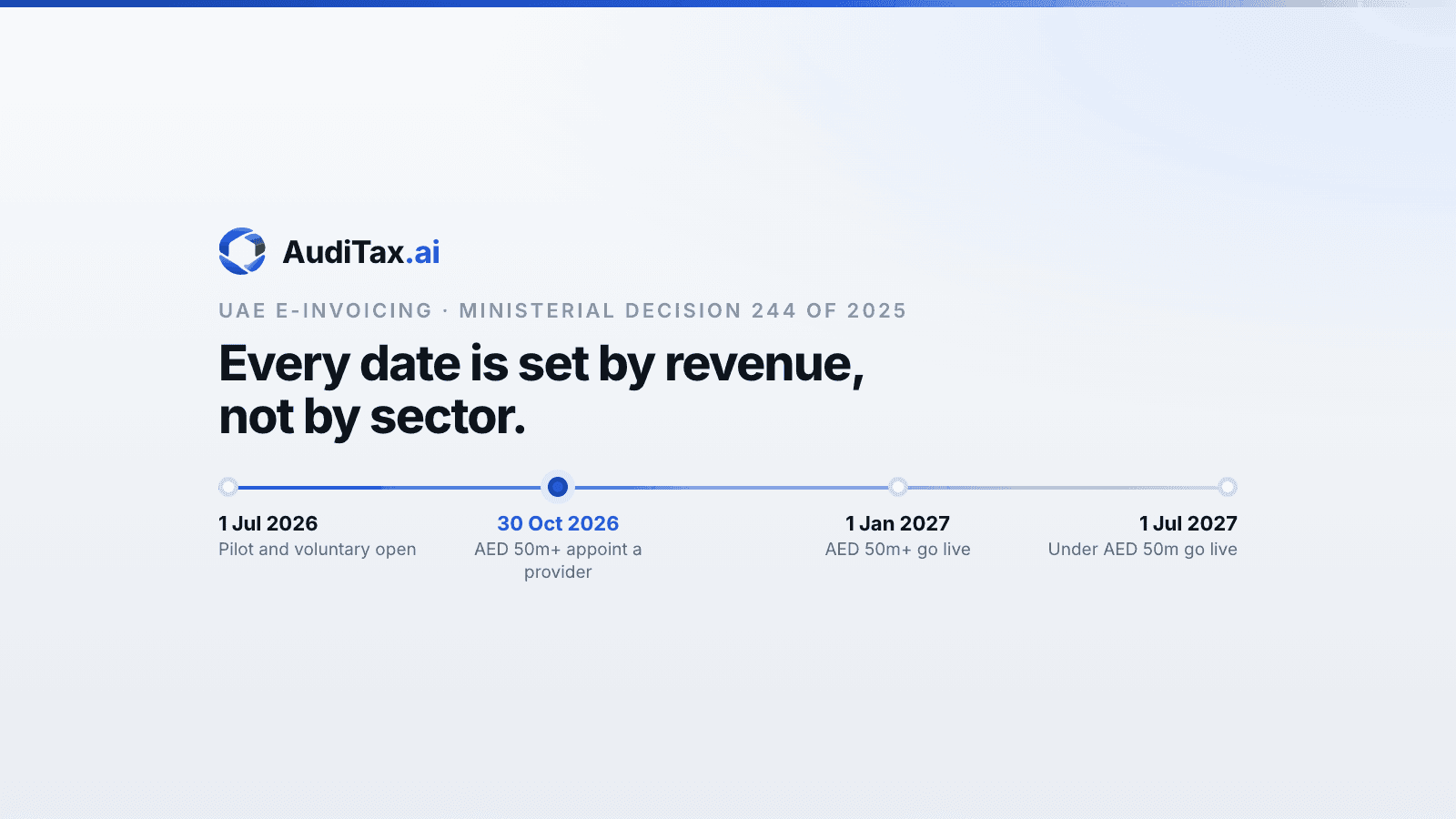
The short answer. UAE e-invoicing arrives in phases set by revenue, not by sector. Businesses with revenue at or above AED 50 million had to appoint an Accredited Service Provider by 30 October 2026 and must be issuing through the system by 1 January 2027. Everyone below AED 50 million appoints by 31 March 2027 and goes live by 1 July 2027. Government entities appoint by 31 March 2027 and go live by 1 October 2027. Business-to-consumer transactions are out of scope for now.
The whole timeline in one table
Every date below comes from Article 5 of Ministerial Decision No. 244 of 2025, as amended by Ministerial Decision No. 66 of 2026.
| Who | Appoint an Accredited Service Provider by | Issuing through the system by |
|---|---|---|
| Pilot programme, by Ministry invitation and written agreement | Not applicable | Pilot began 1 Jul 2026 |
| Anyone joining early, voluntarily | Not applicable | Open from 1 Jul 2026 |
| Revenue at or above AED 50m | 30 Oct 2026 | 1 Jan 2027 |
| Revenue below AED 50m | 31 Mar 2027 | 1 Jul 2027 |
| Government entities | 31 Mar 2027 | 1 Oct 2027 |
| Anyone else subject to the system once those phases are done | To be set by the Ministry | To be set by the Ministry |
Two readings of that table matter more than the dates themselves. The first is that appointment and go-live are separate obligations with separate deadlines, and the gap between them is deliberate: it is onboarding and testing time, not slack. The second is that the AED 50 million line is the only thing that decides which row you are in. There is no industry carve-out and no free zone carve-out.
Which row you are actually in
This is the question that gets answered wrongly most often, because people reach for last year's audited turnover or this year's run rate. Neither is the test.
Article 1 of Ministerial Decision No. 244 of 2025 defines revenue for this purpose as the gross income earned during the most recent accounting period, based on the financial statements prepared under the applicable legislation, or, where those statements are not available, on other documentation acceptable to the Federal Tax Authority.
Three consequences follow, and each one has caught businesses out.
It is gross income, not taxable income and not profit. A business turning over AED 60 million at a thin margin is in the first wave. A business turning over AED 20 million very profitably is in the second.
It is the most recent accounting period, so the answer has a date on it. A company with a June year end and a company with a December year end are reading different sets of financial statements when they answer the same question.
It is measured once for the phase, not continuously. Crossing AED 50 million after your phase was determined does not retrospectively move you into the earlier wave, and sitting just under it does not get you out of the system. It gets you into the second wave.
The date that already moved, and the one that did not
The appointment deadline for the first wave has moved once. Ministerial Decision No. 66 of 2026, published by the Ministry of Finance in May 2026, is a single operative article: it replaces Paragraph (a) of Clause (1) of Article (5) of Ministerial Decision No. 244 of 2025, pushing the Accredited Service Provider appointment date for revenue at or above AED 50 million from 31 July 2026 to 30 October 2026.
What it did not do is move the go-live date. That is the detail worth repeating to a client, because the amendment was widely read as a three-month extension of the whole phase. It was not. It shortened the onboarding window from five months to two.
| Item | As first issued, September 2025 | Position now |
|---|---|---|
| Appointment, revenue at or above AED 50m | 31 Jul 2026 | 30 Oct 2026, moved by MD 66 of 2026 |
| Go-live, revenue at or above AED 50m | 1 Jan 2027 | 1 Jan 2027, unchanged |
| Appointment and go-live, revenue below AED 50m | 31 Mar 2027 and 1 Jul 2027 | Unchanged |
| Appointment and go-live, government entities | 31 Mar 2027 and 1 Oct 2027 | Unchanged |
| Window to transmit an invoice | Not specified in this form | 14 business days from the transaction date, MD 197 of 2026 |
| Invoice data stored inside the UAE | Required | Requirement removed, MD 197 of 2026 |
| Transactions inside a tax group | In scope | Treated as excluded for 24 months from 1 Jan 2027, MD 197 of 2026 |
As at 6 November 2026 the first appointment deadline has passed. A business at or above AED 50 million that has not appointed a provider is not waiting for a deadline: it is already in breach, and the penalty for that runs per month. The go-live date is the next thing in front of it, and it is fixed.
What the October 2026 amendment changed
Ministerial Decision No. 197 of 2026 took effect on 1 October 2026 and amended Ministerial Decision No. 243 of 2025. None of it touched the rollout dates, and all of it reduces work.
- Fourteen business days to transmit. An electronic invoice or credit note must be issued and transmitted through the system within fourteen business days of the date of the business transaction. That is a real window rather than a same-day obligation, and it is business days.
- UAE data residency removed. Invoices and associated data must still be retained for the period the Tax Procedures Law requires, but the requirement to store them inside the UAE is gone. That reopens providers whose infrastructure sits abroad.
- Transactions inside a tax group are excluded for 24 months from 1 January 2027. A tax group here means two or more persons registered with the Authority as a single taxable person for value added tax. Group companies get two years before their internal invoicing has to flow through the system.
- The system-failure notification article was repealed. The separate duty to notify the Authority of a system failure, and the penalty attached to it, are both gone.
The twenty-four month tax-group exclusion is the one most worth acting on, because it changes implementation sequencing. A group can scope its first phase around external invoicing only and leave intra-group flows until 2029.
If you only sell to consumers
Clause 2 of Article 5 of Ministerial Decision No. 244 of 2025 puts business-to-consumer transactions outside the system, and a person engaged exclusively in such transactions outside it altogether, until a decision of the Minister says otherwise.
Two cautions. "Exclusively" is doing the work in that sentence: a retailer that also invoices a landlord, a supplier or a corporate account is not exclusively business-to-consumer, and the business-to-business side of its invoicing is in scope on the ordinary timetable. And the exclusion is explicitly temporary, written as lasting until a further ministerial decision rather than indefinitely.
What missing a date costs
Cabinet Decision No. 173 of 2026 replaced Cabinet Decision No. 106 of 2025 and now sets the penalties. Its annexed table has four entries and no others.
| Violation | Penalty |
|---|---|
| Failure to implement the system, including failure to appoint an Accredited Service Provider | AED 5,000 for the first instance, then AED 5,000 for each month or part of a month that non-compliance continues, capped at AED 50,000 in any twelve consecutive months |
| An electronic invoice not issued and transmitted to the recipient through the system | AED 100 each, up to AED 5,000 per calendar month |
| An electronic credit note not issued and transmitted through the system | AED 100 each, up to AED 5,000 per calendar month |
| Failure to notify the appointed provider of changes to the data registered with the Authority | AED 250 for each day of delay or part of a day, up to AED 5,000 per calendar month |
Three things in that decision are easy to miss and all three are in the reader's favour. The AED 50,000 cap is new: under the repealed decision the monthly charge had no ceiling. Article 3(2) says that where the same person is both issuer and recipient in respect of the same violation, only one penalty applies. And Article 2(2) excepts voluntary participants from the decision entirely, so a business that joined early is outside this penalty regime rather than exposed to it sooner.
Note what is not on the list. There is no penalty for an invoice that is late but transmitted inside the fourteen business days, and there is no longer any penalty attached to notifying the Authority of a system failure.
What this means for a firm
For a practice with a client book, the timeline is really two questions asked per client: which phase they are in, and which of the two dates in that phase is next.
The first question needs the client's most recent financial statements, not a guess, and it needs to be recorded once rather than re-litigated every time someone asks. The second changes as dates pass, which is exactly the kind of thing that drifts when it lives in a spreadsheet.
Worth doing now, in this order. Confirm each client's gross income from their most recent accounting period and write the phase on the file. For any client at or above AED 50 million, check whether a provider was actually appointed before 30 October 2026 and, if not, treat the monthly accrual as live. For every client below the line, 31 March 2027 is the appointment date and the realistic planning assumption is that the provider market will be busier in the first quarter of 2027 than it was in 2026. For groups, decide whether to use the twenty-four month intra-group exclusion before scoping the work, because it changes what has to be ready first.
The wider picture, including the five-corner model and how the system actually works, is in the UAE e-invoicing guide, and the practical readiness steps for a firm are in how firms get ready for e-invoicing. These dates also sit alongside every other client deadline in the UAE compliance calendar.
One thing to be clear about: AudiTax.ai is not an Accredited Service Provider. It does not transmit invoices to the exchange network and it reports nothing to the Federal Tax Authority on anyone's behalf. What it holds is the readiness side, which is the part a practice owns: which client is in which phase, whether a provider has been appointed, and which date is next. Firms looking at the whole picture can start from practice management software for accounting firms.
Sources
- Ministerial Decision No. 244 of 2025 on the Implementation of the Electronic Invoicing System: Article 1 (definition of revenue), Article 3 (pilot programme from 1 July 2026), Article 4 (voluntary implementation), Article 5 (phases and the business-to-consumer exclusion).
- Ministerial Decision No. 66 of 2026 amending Ministerial Decision No. 244 of 2025, published by the Ministry of Finance in May 2026, moving the appointment deadline for revenue at or above AED 50 million to 30 October 2026.
- Ministerial Decision No. 243 of 2025 on the Electronic Invoicing System, as amended by Ministerial Decision No. 197 of 2026, effective 1 October 2026.
- Cabinet Decision No. 173 of 2026 on the violations and administrative penalties resulting from violation of the legislation regulating the Electronic Invoicing System, and its annexed table. Article 4 repeals Cabinet Decision No. 106 of 2025.
- Ministry of Finance, UAE Electronic Invoicing Guidelines version 2.0 dated 26 October 2026, and Electronic Invoice Mandatory Field Requirements version 1.1 dated 28 October 2026.
This article states the position as at 6 November 2026. E-invoicing rules in the UAE changed twice in October 2026 alone, so confirm the current decisions on the Ministry of Finance site before relying on a date.