How to Start an Accounting or Audit Firm in Dubai and the UAE (2026)
An audit firm needs a Ministry professional licence before the emirate will issue an economic licence. The legal forms, the day-one obligations, and why this guide prints no cost figures.
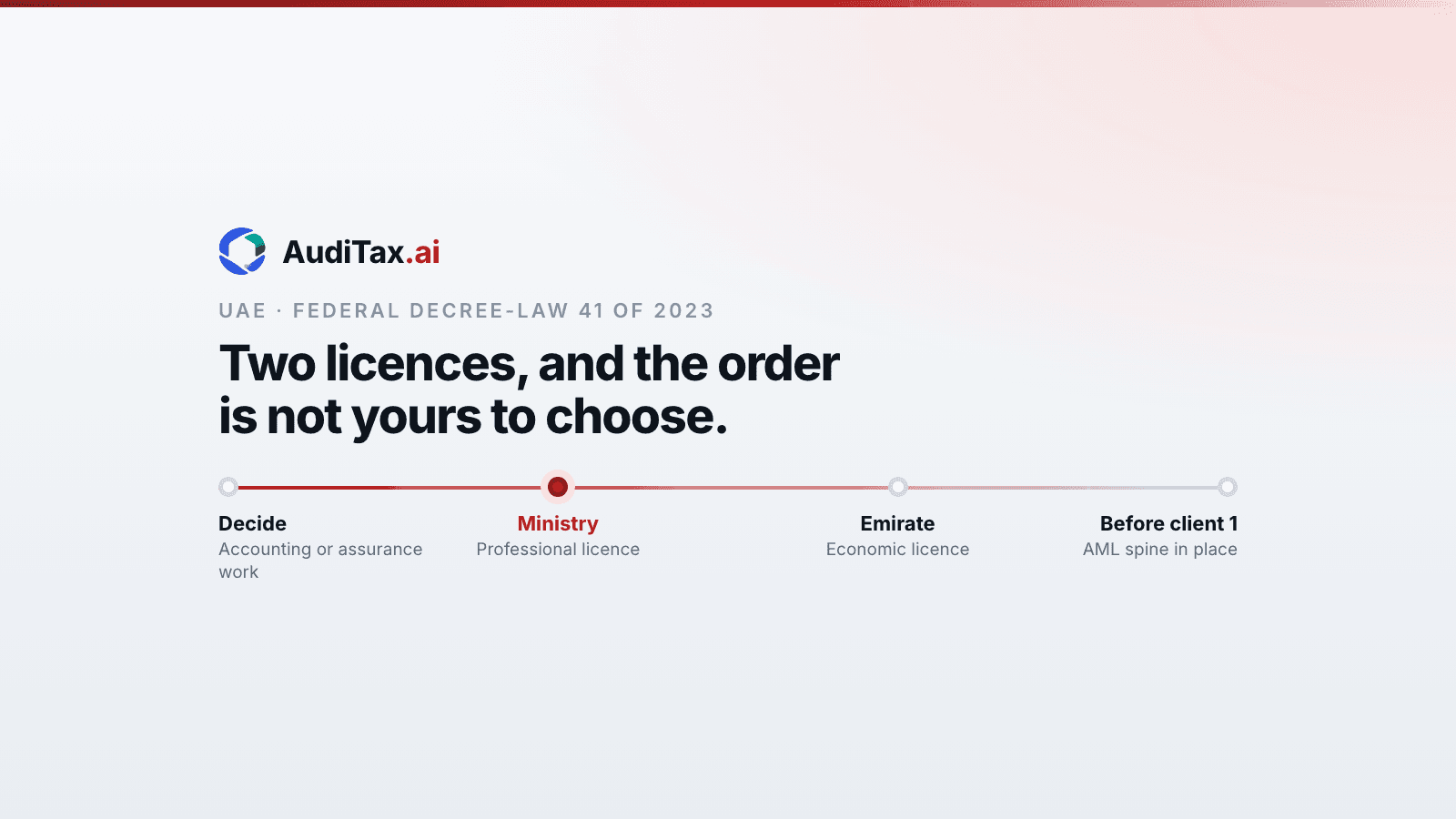
The short answer. Starting a bookkeeping and tax firm in the UAE needs an economic licence for the activity. Starting an audit firm needs two licences: a professional licence from the Ministry of Economy and Tourism first, and an economic licence from the emirate second, in that order. Federal Decree-Law No. 41 of 2023 governs the profession, and it also decides what legal form your firm may take, which is a narrower list than most founders expect.
The first decision is which firm you are actually starting
Almost every mistake in this process traces back to collapsing two different businesses into one word. They have different law, different licences and different founders.
| Accounting, bookkeeping and tax services | Audit and assurance | |
|---|---|---|
| Typical work | Bookkeeping, management accounts, value added tax returns, corporate tax returns, payroll | Auditing and reviewing financial statements, other assurance and related services |
| Professional licence from the Ministry | Not the licensing hook for this work | Required |
| Economic licence from the emirate | Required | Required, and only after the Ministry's approval |
| Who can own it | Ordinary company rules | Restricted legal forms under Article 6 |
| Supervised for anti-money laundering | Yes, as a DNFBP | Yes, as a DNFBP |
Article 4 of Federal Decree-Law No. 41 of 2023 defines the scope of the profession as "auditing and reviewing of financial information and statements as well as other assurances and related services and reports related to financial information", within the standards the Ministry adopts. The definition of other assurance services in the same law stretches further than people assume: it names internal audit, consultancy reports of fiscal monitoring, reliability of electronic information systems and assessment of financial risks.
So the dividing line is assurance, not the word "accounting". If your intended activity list includes anything that provides assurance to third parties about financial information, confirm with the Ministry before you build a business plan around it. The law is titled as regulating the accounting and auditing profession, and the scope article is written around assurance, which is exactly the kind of boundary worth settling in writing rather than by inference.
Two licences, and the order matters
This is the single most expensive sequencing error available to a founder, because getting it wrong means a licence application that cannot complete.
| Licence | Issued by | What it permits |
|---|---|---|
| Professional Licence | Ministry of Economy and Tourism | Practising the profession in the State, for a natural or juristic person meeting the conditions in the Decree-Law and its Executive Regulation |
| Economic Licence | The competent authority in each emirate | Carrying on the licensed activity in that emirate |
The law makes the dependency explicit. An accounting firm must obtain the economic licence before practising the activity, and the authority that issues economic licences in each emirate has to verify that the Ministry's approval has been attained before it issues, amends or cancels the economic licence of the firm or its branches.
Read that twice if you are planning a timeline. The emirate will not finish your file until the Ministry has approved it, and amendments later run through the same check. A founder who books an office and signs a lease against an expected licence date has made an assumption about a process they do not control.
One more constraint with the same flavour. The designation "Chartered Accountant" may not be used unless the professional licence has been issued. That applies to your website and your LinkedIn profile as much as to your letterhead.
The legal forms an audit firm is allowed to take
Article 6 does not leave this to ordinary company law. An accounting firm may practise in the State in one of these forms:
- A professional company consisting of two Chartered Accountants or more.
- A professional company between one or more Chartered Accountants and an international accounting firm.
- A branch of a foreign accounting firm.
- Any other form the Executive Regulation determines.
Separately, a Chartered Accountant may practise individually through their own firm, or by working at a licensed accounting firm or the branch of a foreign one.
Two consequences follow for founders. A professional company route needs at least two licensed Chartered Accountants, so a single licensed professional with a non-licensed business partner is not a configuration that fits paragraph (a). And the firm's name must indicate the activity of the firm, consistent with the economic naming rules in force, which means the branding decision has a legal constraint sitting on it.
What the Decree-Law does not tell you, and where to find it
This is the part where most guides go wrong, and it is worth being precise about.
Federal Decree-Law No. 41 of 2023 does not contain the detailed eligibility conditions for registering as a Chartered Accountant. It does not set out a required degree, a number of accounting credit hours, or a minimum number of years of practical experience. Those conditions are delegated: the law says the Executive Regulation shall determine the types of professional licence and the conditions for licensing each of the forms in Article 6.
Plenty of online guides state specific figures for qualifications and experience and attribute them to this Decree-Law. They are not in it. The figures may well be correct as a matter of the regulations, but the attribution is wrong, and a founder who plans around a misattributed number has no way to check it.
There is also a transitional provision worth knowing. Article 39 keeps the regulations and decisions issued under the previous law, Federal Law No. 12 of 2014 on the Regulation of the Auditors' Profession, in force until the regulations and decisions needed for the new Decree-Law are issued, and in a manner consistent with it. So the operative detail may still sit in instruments made under the old law.
The practical instruction is simple: get the current conditions from the Ministry of Economy and Tourism's own register service and legislation pages, on the day you apply, rather than from any article including this one.
Mainland or free zone
The honest version of this comparison is shorter than most.
For an audit firm, the question is partly answered for you, because the professional licence sits with the Ministry regardless and the economic licence sits with the competent authority wherever you establish. Financial free zones have their own regulators: a firm operating inside the Dubai International Financial Centre or the Abu Dhabi Global Market is licensed and supervised by the Dubai Financial Services Authority or the Financial Services Regulatory Authority respectively, including for anti-money laundering, while mainland and commercial free zone firms answer to the Ministry.
For a bookkeeping and tax practice the choice is an ordinary commercial one about cost, visa allocation, office requirements and where your clients are. The compliance consequence that actually matters is which anti-money laundering supervisor you fall under, because that determines who inspects you and whose guidance you follow.
What does not change in either case: your clients' obligations. A free zone practice still files mainland clients' returns, and the deadlines in the UAE compliance calendar apply to the client, not to where your desk is.
What you are signing up to on day one
The obligations in the Decree-Law start when the firm starts, not when it grows. These are not aspirations, they are the inspection checklist.
| Obligation | What it means for a new firm |
|---|---|
| Compliance with the adopted profession standards | The Ministry adopts the standards; you work to them from the first engagement |
| A professional performance quality control system | Compliant with the quality control standards the Ministry adopts. A two-person firm needs one too |
| Ongoing professional development of employees | Budget and time, recurring, not a one-off |
| Protection and secrecy of customer data | A real information security posture, not a clause in an engagement letter |
| A governance structure or system | Written, even where the structure is small |
| Systems and procedures for anti-money laundering compliance | Named explicitly in the law's own list of firm obligations |
| The Chartered Accountant's approved signature, with both licence numbers on reports | The individual's name and professional licence number alongside the firm's |
| Professional liability insurance | For the firm and the Chartered Accountants working in it, and the firm pays all the premiums |
| Produce reports, documents and working papers to the Ministry on request | Retrievable, not merely existing |
| Report fraud or money laundering discovered during professional services | To the Ministry and the competent bodies |
The insurance line deserves a note in your first budget, because the cost falls on the firm by law rather than on the individual professional. The Ministry has a separate resolution on conditions of insurance against professional error, which is where the detail of acceptable cover lives.
If you plan to audit listed companies or banks
Two additional gates apply, and both have lead times that will not fit a first-year business plan.
A firm may not provide audit and review services to public joint stock companies and mutual funds unless it has obtained accreditation from the Securities and Commodities Authority, whose board sets the controls, conditions and charges.
And a firm appointed by banks, insurance companies, investment funds operating for the benefit of third parties, or public joint stock companies, must hold the Ministry's professional licence for not less than five years.
That five-year rule is the one that shapes a strategy. If regulated-entity audit is the plan, the first five years are spent building a track record on other work, and the business plan has to fund that period rather than assume it away.
The anti-money laundering registration you cannot skip
Whichever firm you are starting, you are a Designated Non-Financial Business or Profession, and this is where new firms are most often found short. The framework changed recently: Federal Decree-Law No. 10 of 2025 repealed the 2018 law and took effect on 14 October 2025, its Executive Regulations are Cabinet Resolution No. 134 of 2025, and the Ministry of Economy and Tourism reissued its DNFBP guidelines in March 2026.
From day one that means a documented risk assessment, customer due diligence on every client before you act for them, a compliance officer whose appointment has the prior written approval of your supervisory authority, registration on goAML so you can file suspicious transaction reports, sanctions screening, and records kept for five years from the latest of several triggers.
The compliance officer approval is the one to start early, because it is an application rather than a decision you make internally, and a new firm has no reason to assume it is quick. The ground-level version of the rest is set out in the KYC and AML checklist for UAE accounting firms.
Three authorities will look at you, and they do not talk to each other
New founders tend to picture a single regulator. There are three, with separate registrations, separate inspections and separate consequences, and being current with one says nothing about the others.
| Authority | What it registers you for | What it comes to look at |
|---|---|---|
| Ministry of Economy and Tourism, as professional regulator | The professional licence, for audit and assurance work | Your quality control system, your working papers, your compliance with the adopted standards |
| Ministry of Economy and Tourism, as anti-money laundering supervisor | Your status as a DNFBP, your compliance officer, your goAML account | Your risk assessment, client identity files, screening records and reporting decisions |
| Federal Tax Authority | Your own corporate tax and, above the threshold, value added tax | Your own returns, your own records, your own payment history |
| Competent authority in the emirate | The economic licence | That the activity, the name and the Ministry's approval all still match |
Two of those rows sit inside the same ministry and are still separate processes with separate files. The profession side refers offences found in its oversight and inspection reports to a Professional Compliance Committee; the anti-money laundering side has its own guidance, its own sanctions and its own inspections. A firm can pass a quality review and fail an AML inspection in the same quarter.
The practical implication for a founder is about record keeping rather than knowledge. Each of these authorities can ask for something on request and expects to receive it without undue delay, which means the working papers, the client identity files and the firm's own tax records all need to be retrievable by a person who was not the one who filed them.
Your own firm is also a taxpayer
It is easy to spend the first year thinking about clients' obligations and forgetting that the firm has its own, on the same calendar.
The firm registers for corporate tax and files a return within nine months of the end of its own first financial year. If its taxable supplies cross the registration threshold it registers for value added tax and files on the periods the Federal Tax Authority assigns, which are assigned rather than chosen; the mechanics are in the UAE value added tax guide. Its trade licence and establishment card renew on their own anniversaries. And if the firm's revenue is modest in the early years, Small Business Relief may be available on election, which reduces the tax but not the obligation to register and file.
None of this is difficult. All of it is forgettable in a first year, which is precisely why it belongs on a system rather than in a founder's head.
What it costs, honestly
This article will not give you a figure, and the reason is worth stating rather than hiding.
There is no neutral published benchmark for the cost of establishing an accounting or audit firm in the UAE. The numbers that circulate come from formation agents who are quoting for their own service, and they vary by emirate, by free zone, by activity list, by visa count and by office type. Publishing a range we cannot source would make this page look more useful and make it less so.
What can be said accurately is what the cost is made of, so you can price it yourself:
- The economic licence and its activity fees, set by the competent authority in your emirate or free zone.
- Ministry fees for the professional licence, which are governed by the published fee decisions.
- Office or flexi-desk, which drives visa allocation in most jurisdictions.
- Visas for the founders and the first hires.
- Professional liability insurance, which the law requires the firm to pay for.
- Quality control and professional development, which are obligations rather than optional spend.
- Working capital for the gap between doing work and being paid for it, which on a new client book is longer than founders plan for.
Get written quotes for the first five from the authority and the insurer directly, on the day. That is a more reliable number than any article's range.
A realistic first ninety days
The order below is driven by dependencies rather than by enthusiasm.
Weeks one and two. Settle which firm you are starting, and if any part of it is assurance work, confirm the position with the Ministry in writing. Decide the legal form against Article 6 rather than against a template, and confirm you have the licensed people that form requires.
Weeks three to six. Start the Ministry professional licence application, because the emirate cannot finish without it. In parallel, get insurance quotes and read the Ministry's current registration conditions rather than any secondary summary.
Weeks five to ten. Economic licence with the competent authority, once the Ministry approval is in hand or clearly in progress. Office and visas follow the licence, not the other way around.
Weeks six to twelve, running alongside. Build the compliance spine before the first client, not after: the AML risk assessment, the policies, the compliance officer application, goAML registration, and the quality control system the law requires. A firm that signs its first client before this exists has created a file it can never make clean retrospectively.
From the first client. Record their own dates from the start. Corporate tax on their financial year end, value added tax on the periods the Authority assigned them, the trade licence anniversary, and when their identity file was last screened. Doing this from client one is free; retrofitting it at client fifty is a project. That is what AudiTax.ai for accounting firms is for, and the free tier carries the compliance tracking, so a new firm can start on the discipline before it can afford anything else. The wider picture is on practice management software for accounting firms.
Sources
- Federal Decree-Law No. 41 of 2023 concerning the regulation of the accounting and auditing profession, issued 28 September 2023, published by the Ministry of Economy and Tourism, read in full: Article 4 (scope of services), Article 5 (Ministry responsibilities), Article 6 (practice of the profession, the permitted legal forms, firm naming), Article 7 (written pledge), the articles on the professional licence and the use of the "Chartered Accountant" designation, Article 14 (economic licence and the Ministry's prior approval), Article 15 (Securities and Commodities Authority accreditation and the five-year licence-holding rule), Article 16 (firm obligations including quality control, anti-money laundering systems, professional liability insurance and the duty to report fraud or money laundering), Article 39 (regulations under Federal Law No. 12 of 2014 remain in force until replaced) and Article 40 (entry into force six months after publication).
- Ministry of Economy and Tourism, auditing and accounts legislation page, for the instruments made under and alongside the Decree-Law, including Cabinet Decision No. 48 of 2022 on the implementing regulation of Federal Law No. 12 of 2014, Cabinet Decision No. 114 of 2022 on Ministry service fees, and Ministerial Resolution No. 111 of 2022 on conditions of insurance against professional error.
- Federal Decree-Law No. 10 of 2025 on anti-money laundering, in force 14 October 2025; Cabinet Resolution No. 134 of 2025; and the Ministry of Economy and Tourism Guidelines for Designated Non-Financial Businesses and Professions, March 2026.
This article states the position as at 6 November 2026. It deliberately does not state registration conditions or setup costs, because the first sit in regulations that may still be transitional and the second have no neutral published source. Confirm both with the Ministry of Economy and Tourism and your licensing authority before committing to anything.