Ministry of Economy AML Guidelines: The 2026 Supplement for Accountants
In April 2026 the Ministry published a thirty-page supplement written for accountants and auditors alone. It rates the sector, adds hard duties, and ends with seven inspection checklists.
The short answer. In April 2026 the Ministry of Economy and Tourism published a Supplemental Guidance for Independent Accountants and Auditors, a thirty-page document written for your sector alone and sitting underneath the main DNFBP Guidelines of March 2026. It rates the sector at medium inherent money laundering risk and medium-low residual risk, adds a short list of hard duties the general guidelines do not spell out, and ends with seven case studies whose "Supervisory Expectations" read as an inspection checklist. It is guidance, not legislation, but it is the document your supervisor wrote about you.
What the April 2026 document is
It is signed by the Director of the Anti-Money Laundering and Terrorist Financing Department at the Ministry of Economy and Tourism and dated April 2026. Thirty pages, structured as introduction, sector and risk context, due diligence and ongoing monitoring, sectoral challenges and best practices, typologies, red flag indicators, seven case studies and a glossary.
It does not stand alone. The main Guidelines for Designated Non-Financial Businesses and Professions, March 2026 carry the general obligations, and the supplement says explicitly that it does not duplicate them. What it adds is sector-specific expectations, risk factors and practical considerations for accountants and auditors, and that is exactly why reading only the general guidelines leaves a gap.
Both documents sit under Federal Decree-Law No. 10 of 2025 and its Executive Regulations, Cabinet Resolution No. 134 of 2025. Those are the instruments that create the obligations. The guidance explains them.
The four supplements, and which one is yours
The Ministry has written a separate supplement for each sector it supervises. If you have been reading the real estate one because it was the first search result, you have been reading someone else's risk profile.
| Document | Who it is for |
|---|---|
| DNFBP Guidelines, March 2026 | All four sectors. The general obligations |
| Supplemental Guidance for Independent Accountants and Auditors, April 2026 | You |
| Supplemental Guidance for Real Estate Agents and Brokers, 2026 | Real estate |
| Supplemental Guidance for Dealers in Precious Metals and Stones, 2026 | Gold and jewellery |
| Supplemental Guidance for Trust and Company Service Providers, 2026 | Corporate service providers |
The scope line is worth reading carefully. The accountants supplement covers professionals acting independently, whether as sole practitioners or as members or employees of firms engaged primarily in audit and accounting-related services. A one-person practice is inside it.
The risk rating the Ministry has put on your sector
This is the part most firms have never seen stated, and it is useful because it tells you how your supervisor is thinking before the first inspection question.
Drawing on the 2024 National Risk Assessment and the Ministry's own 2024 Sectoral Risk Assessment, the supplement says the sector has not been widely associated with systemic abuse for terrorist financing, but carries vulnerabilities around the misuse of professional services to layer illicit funds, conceal beneficial ownership and operate complex cross-border corporate structures. The conclusion is a medium level of inherent money laundering risk with a medium-low residual risk, the gap between the two being credited to the sector's gatekeeping role and its professional standards.
Two implications follow. Medium inherent risk means a firm claiming a low-risk business-wide assessment is arguing against its own supervisor's published position and needs to show why. And medium-low residual means the Ministry already assumes your controls are doing work, which is a quieter way of saying it expects to find them.
The risk question has two sides, and most firms answer one
The supplement makes a structural point that the general guidelines do not. An accountant approaches risk identification from two complementary perspectives, and a firm that has done only the first has done half the work.
The first is the risk arising from your own professional activities and business operations: which services you sell, to whom, through what channel, and what your fee arrangements look like. That is the business-wide risk assessment every DNFBP owes.
The second is the risk arising from your clients, specifically the situations where your services could be misused by them. The supplement is blunt about where that bites: the sector may inadvertently authenticate financial statements used to disguise illicit funds, support the incorporation of entities, or produce documentation used by international laundering networks or for sanctions and tax evasion.
There is a third layer for a particular kind of engagement. Where you are reviewing or testing a client's internal controls, risk management or AML programme, through internal audit, advisory or assurance work, you are expected to evaluate the adequacy and effectiveness of their risk identification framework: whether the risk factors are appropriate, whether the methodology is documented and consistently applied, whether the compliance officer and senior management are actually involved, and whether anyone reviews it periodically. The guidance states plainly that deficiencies in a client's risk framework raise the chance their business is misused.
And the supplement asks you to calibrate controls by service as well as by client. Company structuring, complex cross-border arrangements, liquidation or insolvency work linked to unexplained wealth, and non-routine financial transactions should attract enhanced scrutiny from engagement acceptance onward, whoever is asking for them. A low-risk client buying a high-risk service is not a low-risk engagement.
The sentence that changes how you read it
Buried in the introduction is the drafting convention, and it decides what the rest of the document obliges you to do.
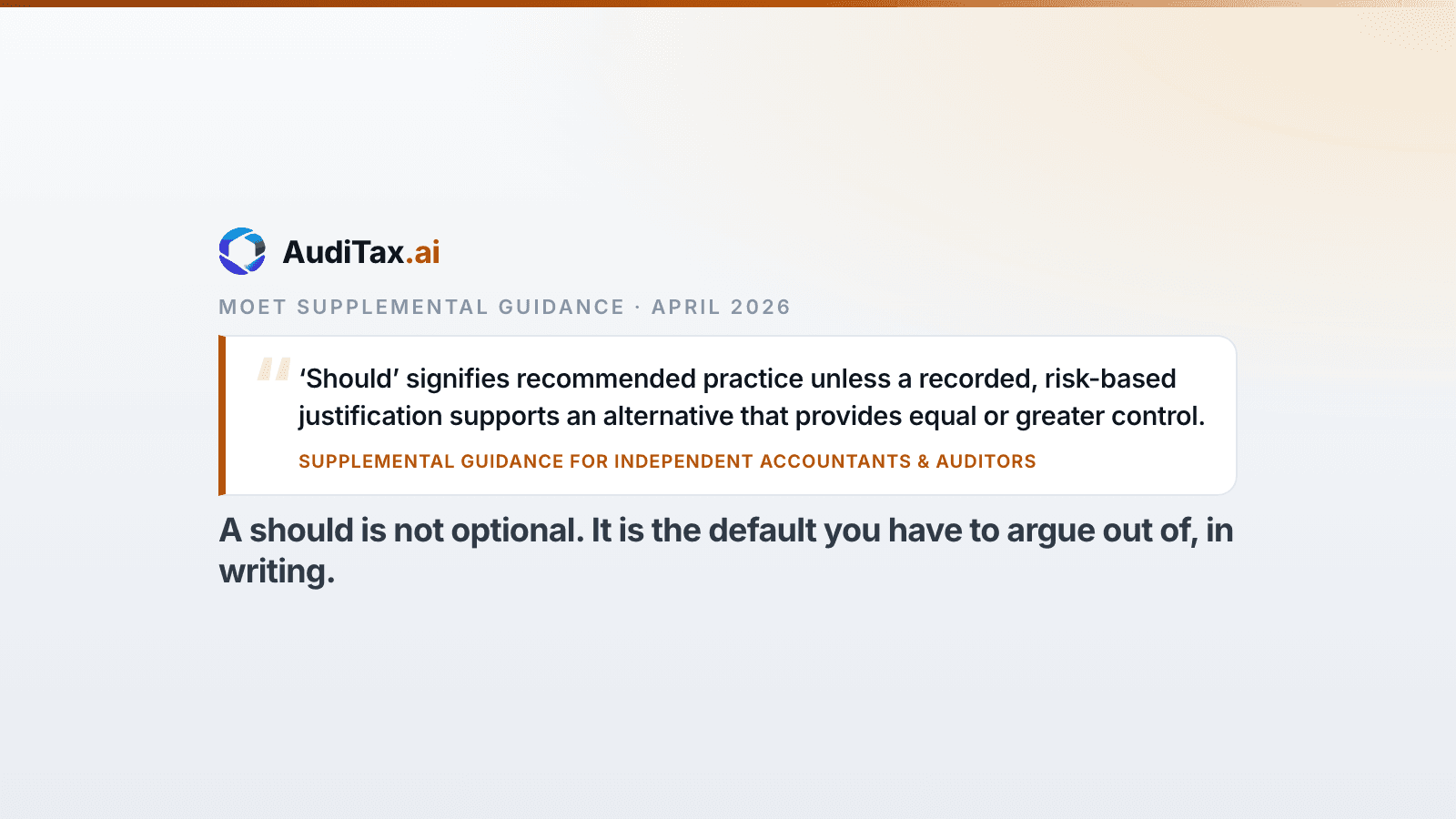
Requirements written with shall or must are compulsory. Should signifies recommended practice, unless a recorded, risk-based justification supports an alternative that provides equal or greater control.
Read that again, because it is not the usual soft-law formula. A "should" is not optional. It is the default, and departing from it costs you a written, risk-based justification that your alternative is at least as strong. A firm that quietly skips a "should" and writes nothing has not exercised judgement, it has created a finding.
The legal status section is equally direct about what the document cannot do for you. It is not legislation and sets no precedent, the law prevails over it in any conflict, and nothing in it is a guarantee that a supervisor will defer, waive or refrain from enforcement.
Three duties written as must that firms miss
Most of the supplement elaborates obligations you already have. These three are stated as hard requirements and are routinely read as softer than they are.
| The duty | What it rules out |
|---|---|
| Refuse or exit a relationship where beneficial ownership or the source of funds cannot be reasonably verified, or where sanctions and proliferation financing risk cannot be mitigated | Carrying a client while the ownership question stays open. The supplement does not offer monitoring as a substitute |
| Apply risk-driven due diligence rather than threshold-driven due diligence | Using transaction value as the trigger. The wording is explicit that reliance on value alone must not result in material risk indicators being overlooked |
| Report where reasonable grounds for suspicion exist, regardless of the value of the transaction, and including attempted activity | Waiting for a threshold, and assuming that declining a client ends the matter. Attempted activity includes a relationship you refused after due diligence |
The third one catches firms that do the right thing and then stop. If you decline an engagement because of what due diligence turned up, the refusal itself is the reportable event, and the obligation does not depend on certainty or proof.
Against that, the supplement gives back something firms often get wrong in the other direction. Declining a transaction, delaying a service or asking for more information for legitimate compliance purposes does not constitute tipping off, provided it is done in a way that does not reveal the existence of a report or a suspicion. The thing you may not do is tell them why.
Red flags written for an accountant, not for a bank
The red flag section runs for four pages and most of it is familiar. What makes it worth reading is the handful of indicators that only make sense inside a professional engagement.
| Indicator | Why it is in a document about money laundering |
|---|---|
| The client asks you to "simplify" explanations, accept management representations without evidence, or exclude certain accounts, transactions or jurisdictions from scope | Scope is the control. Narrowing it is the cheapest way to keep a structure out of view |
| The client wants the work done in an unreasonably short time and will pay substantially higher fees for it | Speed buys the absence of questions, and the premium prices it |
| The choice of your firm is unexplained given its size, location or specialisation | A client who travelled past the obvious options chose something about you |
| Frequent or unexplained changes of professional adviser | A pattern of leaving before anyone finishes looking |
| Ownership changes without the accountant being told | The structure moved while you were still assuring the old one |
| The client is very interested in your due diligence and reporting procedures | Asking how the alarm works is not the same as asking whether there is one |
| Attempts to influence the accuracy of your work, including through inducement or pressure | Named in the guidance as a due diligence factor, not just an ethics problem |
The through line is that the supplement treats your professional judgement as the control being attacked. Every one of those indicators is an attempt to buy, hurry or narrow it.
Your own fee is a monitoring point
This is the section most likely to be new to a practice, and it is short enough to act on immediately.
When collecting fees or reimbursing expenses, the guidance says to ensure that funds come from known sources on which you have performed due diligence, not from third parties, foreign accounts or other unknown sources, and that the payment method is consistent with the client's profile. It then names the methods that are not: cash, cashier's cheques, postal money orders, prepaid cards, third-party endorsed cheques and cryptocurrencies.
The reasoning is that your fee is itself a transaction, and an accountant paid by a party who is not the client has a relationship they have not documented. Most firms have never looked at their own receipts this way, and the fix is a line in the engagement terms plus a check at the point of receipt.
Supervisory Expectations is the part to read as a checklist
Each of the seven case studies ends with a block headed "Supervisory Expectations". Read the seven blocks together and the same instructions repeat, which is as close as a regulator comes to publishing its inspection questions.
| What recurs across the seven cases | What it asks you to be able to show |
|---|---|
| Apply enhanced scrutiny to complex structures, offshore entities, intermediaries and opaque ownership without a clear rationale | That you noticed, and that the file says so |
| Assess whether declared wealth, source of funds and ownership are consistent with what you observed | A comparison, not a collection of documents |
| Verify beneficial ownership through reliable and independent sources | Corroboration, not the client's own statement |
| Apply professional scepticism to accounts, incorporation records, invoices and supporting documents | That you tested the paperwork that justified the money |
| Where reasonable grounds for suspicion arise, assess whether to report | That the question was asked, even when the answer was no |
| Maintain sufficient documentation of the review performed, the inconsistencies found and the conclusions reached | The whole thing again, in writing, afterwards |
The last row appears in all seven. Every case study ends by asking for the record, which tells you what an inspection actually tests: not whether you made the right call, but whether anyone can see that you made one.
What the Sectoral Risk Assessment says about small firms
The supplement names, without softening it, where the Ministry thinks the sector is weakest. Its Sectoral Risk Assessment found uneven compliance maturity across firms, especially smaller practices, and lists the causes: limited dedicated compliance resources, gaps in escalation to senior management, insufficient tailored training and over-reliance on manual processes.
The consequences it names are inconsistent risk assessments, weak documentation of decisions and under-identification of suspicious activity. A small firm reading that should assume its supervisor arrives expecting exactly those four weaknesses and will look for them first.
Separately, the supplement states that the timeliness of reporting and the quality of reports continue to be key supervisory focus areas for the sector. Not whether you report, but how fast and how well.
One citation worth noticing
The introduction describes who an auditor is by reference to Federal Law No. 12 of 2014 on the Regulation of the Auditors' Profession. That law was repealed by Article 39 of Federal Decree-Law No. 41 of 2023, which now regulates the profession.
This changes nothing about the guidance's substance. The sentence is descriptive scene-setting about who accountants and auditors are, the same description carries into the 2023 decree-law, and Article 39 keeps the regulations and decisions issued under the 2014 law in force until replacements are issued. But it is a reminder worth carrying into any AML reading this year: the legal furniture moved several times in eighteen months, and documents written quickly during a transition inherit old citations. Check the instrument, not the summary.
What to do with it this week
Four things, none of which needs a project.
Put the risk rating in your business-wide risk assessment. If your assessment predates April 2026 and rates the sector low, it now contradicts a published position, and that is the easiest finding an inspector can write.
Re-read your "should" exceptions. Anywhere your procedures depart from the guidance, there must be a recorded, risk-based justification that the alternative is as strong. If there is no document, there is no justification.
Check how you get paid. One line in the engagement terms, one check at receipt. Third-party payments, unfamiliar foreign accounts and the listed instruments are the ones to catch.
Use the Supervisory Expectations blocks as a file review. Take two higher-risk clients and test their files against the six recurring items in the table above. What you find is what an inspection would find.
All four are evidence problems before they are judgement problems, and that is where a practice tends to lose. AudiTax.ai's client KYC and AML keeps identity checks, risk ratings and re-screening on the client record itself rather than in a parallel folder, so the comparison the Supervisory Expectations ask for exists before anyone asks for it, and the document vault holds the trade licences, passports and signed engagement letters in one searchable place instead of across email and chat. The underlying obligations are set out in full in the complete DNFBP guide for UAE accountants and auditors, the client identity file itself is covered in the KYC and AML checklist, and the broader evidence discipline an inspection tests is in audit readiness and client records.
Sources
- Ministry of Economy and Tourism, Countering Money Laundering, Terrorism Financing and Proliferation Financing: Supplemental Guidance for Independent Accountants and Auditors (IAA), April 2026, thirty pages, read in full. Used for the sector risk rating, the shall and should convention, the legal status section, the refuse or exit duty, the risk-driven rather than threshold-driven requirement, the reporting and tipping-off sections, the fee collection guidance, the sectoral challenges, the red flag indicators and the seven case studies with their Supervisory Expectations.
- Ministry of Economy and Tourism, Guidelines for Designated Non-Financial Businesses and Professions, March 2026, seventy-six pages, which the supplement sits underneath and which confirms the four supervised sectors and the existence of dedicated supplemental guidance for each.
- Federal Decree-Law No. 10 of 2025 on Anti-Money Laundering and Combating the Financing of Terrorism and Proliferation Financing, and Cabinet Resolution No. 134 of 2025 on its Executive Regulations, which are the instruments the guidance explains.
- Federal Decree-Law No. 41 of 2023 on regulating the accounting and auditing profession, Article 39, which repeals Federal Law No. 12 of 2014 and keeps the regulations and decisions issued under it in force until replacements are issued.
This article states the position as at 6 November 2026 and summarises a guidance document rather than replacing it. The supplement is thirty pages and free; a firm relying on this summary alone has done the thing the document warns against.