The New UAE VAT Penalty Regime From 14 April 2026: What Changed
The old 2% plus 4% a month is gone, replaced by a flat 14% a year. On six months of unpaid tax that is the difference between 26% and 7%. The before, the after, and the waiver route.
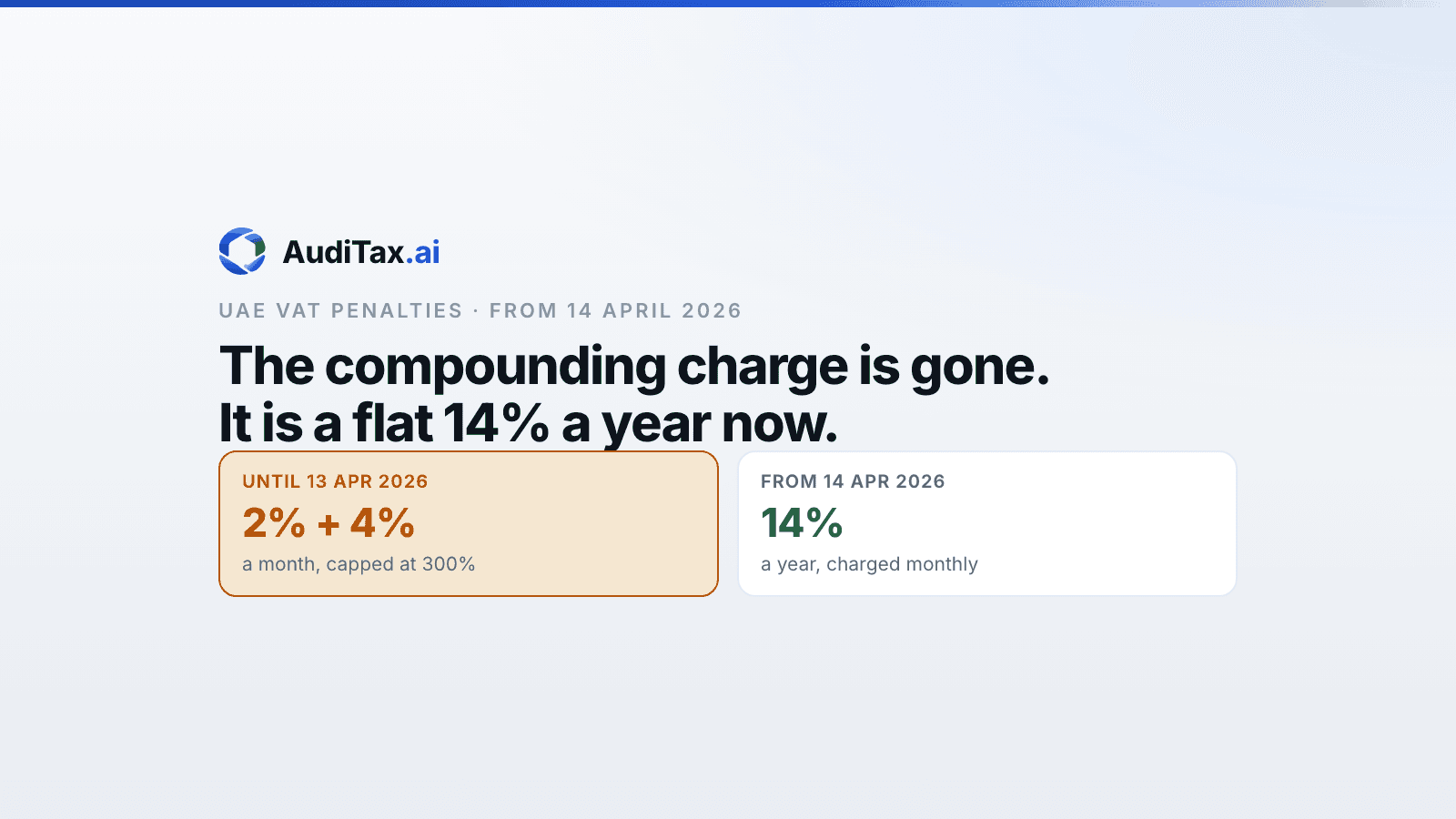
The short answer. On 14 April 2026 Cabinet Decision No. 129 of 2025 amended Cabinet Decision No. 40 of 2017, rewriting the value added tax and excise penalty framework that had run since Cabinet Decision No. 49 of 2021 amended the same decision. The headline change is late payment: the old charge of 2% immediately plus 4% every month, capped at 300%, is gone, and in its place is a flat 14% a year calculated monthly. Late registration is still AED 10,000. Late filing is AED 1,000, rising to AED 2,000 for a repeat within twenty-four months. Voluntary disclosure now costs 1% a month. A penalty can still be waived or paid in instalments, but only on defined grounds.
What actually changed
The reform is a simplification, and for most taxpayers it is also a reduction. The old structure compounded in a way that was hard to predict and hard to explain to a client.
| Violation | Until 13 April 2026 | From 14 April 2026 |
|---|---|---|
| Paying late | 2% of the unpaid tax the day after the due date, then 4% every month, capped at 300% | 14% a year, calculated monthly from the day after the due date |
| Registering late | AED 10,000 | AED 10,000, unchanged |
| Filing late | AED 1,000, then AED 2,000 for a repeat within 24 months | AED 1,000, then AED 2,000 for a repeat within 24 months |
| An incorrect return that does not change the tax due | Fixed penalty | AED 500 |
| Not updating tax records | AED 5,000, then AED 10,000 | AED 1,000, then AED 5,000 for a repeat |
| Records not kept in Arabic | AED 20,000 | AED 5,000 |
| Voluntary disclosure | Tiered percentages | 1% a month on the tax difference |
Note what this framework does not cover. The consolidated decision defines "Tax Law" as the Excise Tax Law and the Value Added Tax Law, and corporate tax is not in it. Corporate tax penalties keep their own schedule in Cabinet Decision No. 75 of 2023, which April 2026 left untouched, so a firm advising on both still holds two sets of numbers rather than one.
A worked example, because the percentages hide the size of it
Take a client who underpaid AED 100,000 of value added tax and settles it six months late.
| Months late | Old regime | New regime |
|---|---|---|
| 1 month | AED 6,000 (2% + 4%) | AED 1,167 |
| 6 months | AED 26,000 (2% + 24%) | AED 7,000 |
| 12 months | AED 50,000 (2% + 48%) | AED 14,000 |
| 24 months | AED 98,000 (2% + 96%) | AED 28,000 |
At six months the difference is AED 19,000 on a single AED 100,000 exposure. At two years the old regime had almost doubled the debt while the new one has added just over a quarter.
The 300% cap tells you how far the old structure could run: at 4% a month it took a little over six years to get there, and a dormant liability sitting in a client's books could quietly do it. The new rate has no such trajectory, which is the real change. It converts a penalty that could outgrow the tax into something closer to interest.
Two things that are easy to get wrong when quoting this to a client. The 14% is calculated monthly, for each month or part of a month, so one day into a new month is a full month's charge. And it runs from the day after the due date, not from when the authority notices.
Every VAT penalty as it stands now
| What happened | Penalty |
|---|---|
| Did not register when required | AED 10,000 |
| Did not deregister within the deadline | AED 1,000, then AED 1,000 a month, capped at AED 10,000 |
| Filed the return late | AED 1,000; AED 2,000 for a repeat within 24 months |
| Paid late | 14% a year on the unpaid tax, charged monthly |
| Filed an incorrect return with no effect on tax due | AED 500 |
| Did not notify a change to tax records | AED 1,000; AED 5,000 for a repeat |
| Did not keep records in Arabic on request | AED 5,000 |
| Voluntary disclosure before any audit notification | 1% a month on the tax difference |
The deregistration penalty is the one firms forget, because it arrives when a client is winding down and nobody is watching the tax file. It is covered in the full value added tax guide, along with the twenty-business-day clock that triggers it.
Voluntary disclosure: the cheapest route to a correction
When a past return understated tax by more than AED 10,000, a voluntary disclosure is required within twenty business days of discovering the error. At or below AED 10,000 the correction goes in the next return that has not yet fallen due.
The new penalty is 1% of the tax difference for each month, running from the original due date of the return until the disclosure is submitted. That replaces the tiered percentages, and the arithmetic now rewards speed in a way the old structure did not: every month you sit on an error adds a percentage point.
The point worth making to clients is that the clock starts at the original due date, not at discovery. An error found two years later already carries twenty-four months of charge before the disclosure is filed. Finding errors on a schedule is cheaper than finding them when the authority does.
If you think the penalty is wrong: reconsideration
A waiver asks the authority to excuse a penalty that was correctly imposed. Reconsideration argues it should not have been imposed at all, and it is a different route with a much tighter clock.
A reconsideration request must reach the Federal Tax Authority within 40 business days of being notified of the decision, in Arabic, with the documentary evidence attached. The authority then has 40 business days to decide, and if it does not decide in that window the request is treated as rejected.
If it is refused, the next step is an objection to the Tax Disputes Resolution Committee, again within 40 business days of receiving the decision, and from there to the Federal Courts.
Three things make firms miss this. The clock runs in business days, excluding weekends and official holidays, and it starts the day after notification rather than on it. The submission must be in Arabic, which is a drafting job, not a translation at the last minute. And forty business days is roughly two calendar months, which sounds generous until the evidence has to be collected from a client who is not treating it as urgent.
Reconsideration and waiver are not alternatives to be tried in sequence once one fails. Which one applies depends on whether the penalty was correctly imposed, and that question is worth settling before either form is started.
Can a VAT penalty be waived?
Yes, on defined grounds, and the route is older than the 2026 reform. Cabinet Decision No. 105 of 2021, in force since 1 March 2022, sets the rules for waiving administrative penalties and for paying them in instalments.
Instalments. A request can be considered where the penalties are unsettled, the amount is at least AED 50,000, and the penalties are not the subject of a case before the Tax Disputes Resolution Committee.
Waiver. A committee may approve a full or partial waiver where the circumstances justify it. The recognised grounds are narrow and evidential rather than sympathetic: a malfunction of the authority's own systems, the death or serious illness of the person responsible for the taxpayer's affairs, and restrictions imposed by a government authority are the kinds of circumstances contemplated.
Two practical notes. A waiver is never automatic, and "we did not know" is not a ground. And the service states a review period of up to 110 business days for a completed application, so this is not a way to resolve a cash-flow problem that lands next month.
What this means for a practice
Three consequences follow, and the first is the awkward one.
Your old exposure figures are wrong, and wrong in the client's favour. A firm that has been using the compounding numbers to push a client into paying is now quoting a figure that overstates the risk. That is a credibility problem the first time a client checks. Any penalty estimate produced before April needs redoing.
The cheaper rate is not a reason to deprioritise payment. Fourteen per cent a year is still well above the cost of most borrowing, and it sits on top of the fixed penalties, which did not fall. A client treating the new rate as affordable finance has misread it.
The fixed penalties are now the bigger share for small liabilities. On AED 5,000 of late tax, six months of late payment charge is AED 350 while the late filing penalty alone is AED 1,000. For small registrants the discipline that matters is filing on time, not paying fast.
All of which is a scheduling problem rather than a knowledge problem. The dates that generate these penalties are the same dates every month: a value added tax return due on the twenty-eighth of a period the authority assigned, sitting alongside corporate tax on the client's own year end and licence renewals on their own anniversaries. They are set out together in the UAE compliance calendar, and the corporate tax equivalent of this post, for a deadline that has already passed, is here.
Holding them per client is what AudiTax.ai's notifications are for: the alert goes to the person who owns the deadline rather than to the whole team, through in-app, push and email from one dispatch point, and it fires on the client's real dates rather than a generic calendar. Firms looking at the whole picture can start from practice management software for accounting firms.
Sources
- Cabinet Decision No. 40 of 2017 on the administrative penalties for violation of tax laws in the UAE and its amendments, including Cabinet Decision No. 49 of 2021, Cabinet Decision No. 108 of 2021 and Cabinet Decision No. 129 of 2025, the last issued 9 October 2025 and in force 14 April 2026. The consolidated decision defines Tax Law as the Excise Tax Law and the Value Added Tax Law.
- Cabinet Decision No. 75 of 2023 as amended by Cabinet Decision No. 10 of 2024, cited only to show that corporate tax penalties sit in a separate schedule that the April 2026 amendment did not change.
- Federal Tax Authority announcement on the entry into force of the amended administrative penalties.
- Cabinet Decision No. 105 of 2021 on the instalment and waiver of administrative penalties, in force 1 March 2022.
- Federal Tax Authority guidance on voluntary disclosure and the AED 10,000 threshold.
- Federal Decree-Law No. 28 of 2022 on Tax Procedures, on reconsideration requests and objections to the Tax Disputes Resolution Committee.
This article states the position as at 5 November 2026. Penalty figures change; confirm a client's own position in EmaraTax before relying on an estimate.