VAT Voluntary Disclosure in the UAE: What It Costs and When
Priced by time, not size: 1% of the tax difference a month from the day after the return was due. If the Authority notifies an audit first, a fixed 15% lands on top.
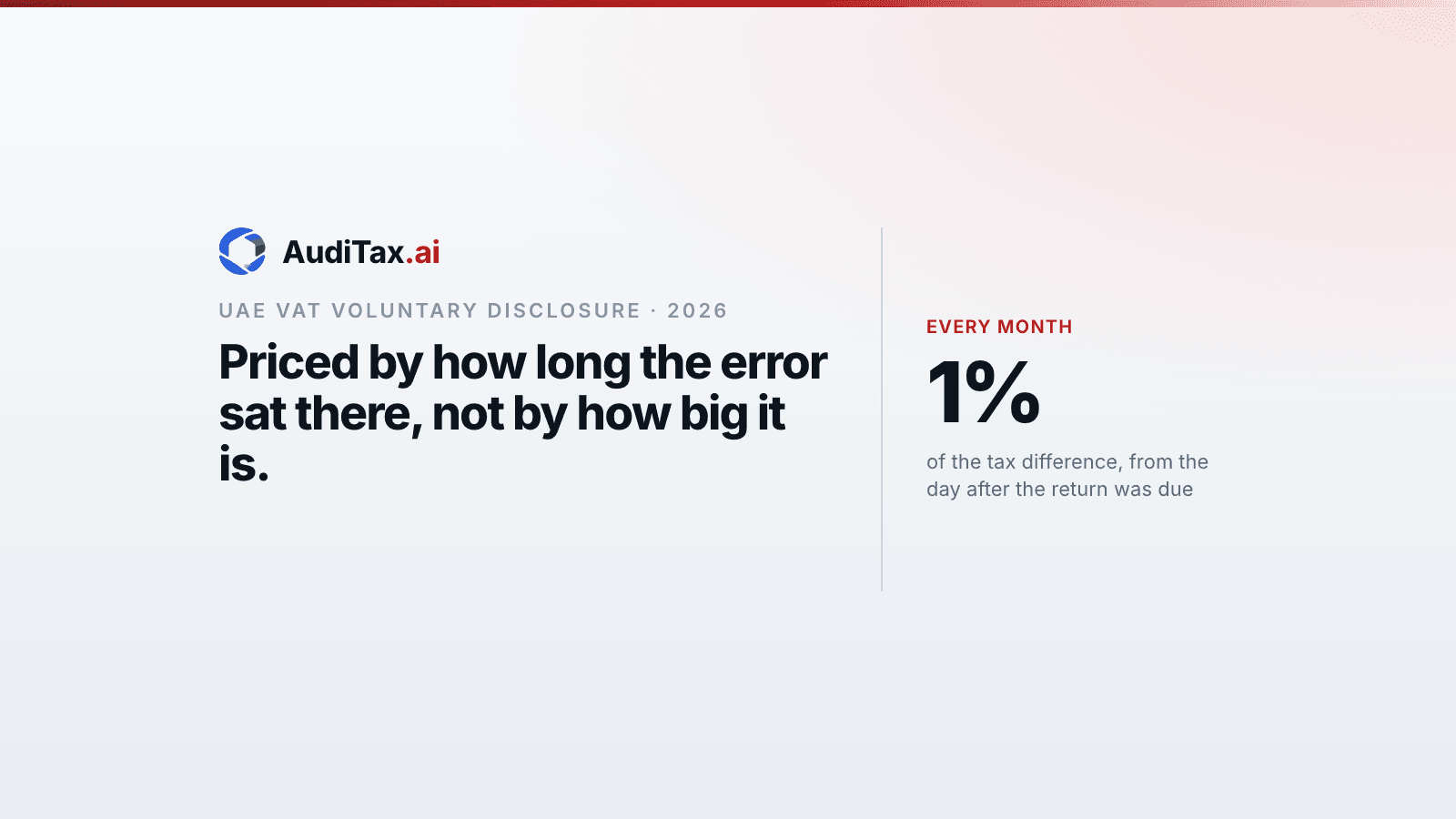
The short answer. A VAT voluntary disclosure is priced by time, not by size. Since 14 April 2026 it carries 1% of the tax difference for each month or part of a month, running from the day after the original return was due until the day you submit the disclosure. If the Authority notifies you of a tax audit first, a fixed 15% of the tax difference lands on top. And the tax you disclose becomes payable 20 business days after you submit, not immediately.
What a voluntary disclosure actually is
Cabinet Decision No. 40 of 2017, as amended, defines it precisely: a form prepared by the Authority by which the taxpayer notifies the Authority of any error or omission in the tax return, tax assessment or tax refund application, in accordance with the Tax Procedures Law.
Three things follow from that definition and are worth fixing before the arithmetic.
It covers more than returns. A tax assessment and a refund application are both in scope, which catches firms who think a disclosure only exists for a filed return.
It is the Authority's form, not a letter. There is no informal route.
And the quantity being penalised is the tax difference, which the decision defines as the difference between the due tax as calculated and the due tax as it should have been calculated. Not the turnover involved, not the invoice value, and not the output tax on its own.
What is in scope, and what has a cheaper route
The definition names three documents, and the penalty row about incorrect returns names two exceptions. Put together, they sort the ordinary cases.
| What happened | Route |
|---|---|
| Output tax understated on a filed return | Voluntary disclosure. There is a tax difference |
| Input tax over-recovered on a filed return | Voluntary disclosure. The difference runs the other way but it is still a difference |
| A refund application claimed more than you were entitled to | Voluntary disclosure. The definition names the refund application, and the 1% runs from its submission date rather than a return due date |
| An error in a tax assessment the Authority issued | Voluntary disclosure. The definition names the assessment too |
| A presentation error that does not change due tax | Voluntary disclosure, and the AED 500 incorrect return penalty does not apply because the correction produces no difference in due tax |
| You spot the error before the deadline for submitting that return | Correct the return itself. This is the other exception listed in the same row, and no disclosure is in play yet |
The last two rows are where money is saved. One avoids the fixed charge because the tax does not move; the other avoids the question entirely because the deadline has not passed.
The two prices
The penalties sit in the table appended to the decision, which was amended by Cabinet Decision No. 129 of 2025 with effect from 14 April 2026.
| Situation | Penalty |
|---|---|
| You submit a voluntary disclosure on errors in a return, assessment or refund application | 1% of the tax difference for each month or part of a month, from the day after the return was due, or the refund application was submitted, until the disclosure is submitted |
| You fail to submit one before the Authority notifies you that you will be subject to a tax audit | A fixed 15% of the tax difference, plus 1% a month on the same basis |
| You submit an incorrect return and then disclose, but the correction makes no difference to due tax | No AED 500 penalty for the incorrect return |
Read the second row carefully. The 15% is not a penalty for the error. It is a penalty for not having disclosed by the time the audit notification arrived, and it attaches whether you disclose afterwards or never disclose at all. The only difference the later disclosure makes is where the 1% monthly charge stops: at the disclosure date if you file one, or at the date the tax assessment is issued if you do not.
The clock starts at the return's due date, not at discovery
This is the single most expensive misunderstanding in the whole area, and it is the reason the cost is a function of age rather than amount.
The 1% runs from the day following the due date of the tax return, or the submission of the refund application. Not from when you found the error, and not from when you were in a position to find it. An error discovered three years late already carries thirty-six months of charge on the day you discover it.
Take a tax difference of AED 80,000 and vary only how long it sat there.
| Months since the return was due | Disclosed voluntarily | Disclosed after an audit notification |
|---|---|---|
| 3 months | AED 2,400 | AED 14,400 |
| 12 months | AED 9,600 | AED 21,600 |
| 24 months | AED 19,200 | AED 31,200 |
| 36 months | AED 28,800 | AED 40,800 |
The tax difference is identical in every row. The only variable is time, and in the right-hand column the AED 12,000 fixed charge is the same in every row too, which is what makes it so punishing on a small difference and so comparatively mild on a large one.
The practical consequence is that a historic review has a price attached to delay. Every month spent deciding whether to disclose adds a percentage point to the thing you are deciding about.
Why "each month or part thereof" matters
The decision says each month or part thereof. One day into a new month is a full month's charge, on both the 1% and the 14% late payment penalty.
There is also a drafting detail in a footnote that almost nobody reads, carried over from Cabinet Decision No. 49 of 2021. Where a penalty falls on the same date monthly and a month has no corresponding date, the date is treated as the first day of the following month, and every subsequent month is charged on the date the monthly penalty was first imposed.
In plain terms: a monthly charge anchored to the 31st does not vanish in February. It moves to 1 March, and the anchor for later months stays where it started.
The disclosure that costs nothing
Not every correction triggers a charge, and the exception is in the row about incorrect returns.
Submitting an incorrect tax return is AED 500, unless the registrant either corrects the return within the deadline for submitting it, or submits a voluntary disclosure to correct it without resulting in a difference in the amount of due tax.
So a correction that changes the presentation but not the tax has a clean route. Misclassified a zero-rated supply as exempt with no effect on the net position, or reported the right total in the wrong box, and the disclosure fixes the record at no cost. The 1% charge is calculated on the tax difference, and where the tax difference is nil there is nothing to apply it to.
That makes the first question on any error not "how big is it" but "does it change due tax". The two have different answers surprisingly often.
After you file: twenty business days to pay
This one is routinely missed, and it is good news for anyone planning the cash.
The 14% a year late payment penalty runs from the day following the due date of payment. For a voluntary disclosure, the decision sets that due date as 20 business days from the date of submission. For a tax assessment it is 20 business days from the date of receipt.
So submitting the disclosure does not make the tax instantly overdue. You have a defined window, in business days rather than calendar days, and the 14% only begins after it. What the window does not do is pause the 1%, which already stopped when you submitted.
Three clocks, and only one of them you can stop
It helps to see them separately, because they start at different moments and only one responds to anything you do today.
| Charge | Starts | Stops |
|---|---|---|
| 1% a month on the tax difference | The day after the return was due, or the refund application was submitted | The day you submit the voluntary disclosure. If you never submit one, the day the tax assessment is issued |
| Fixed 15% of the tax difference | Triggered once, by the Authority notifying you of a tax audit before you disclosed | It does not run. It is a one-off amount and a later disclosure does not remove it |
| 14% a year on unsettled payable tax, charged monthly | The day after the payment due date, which for a disclosure is 20 business days after you submit it | When the tax is paid |
Only the first clock is in your hands, and the way to stop it is to submit. The second is decided by who moves first. The third is a payment question rather than a disclosure one, and it starts after a window the decision gives you deliberately.
The threshold and the deadline live in a different law
Everything above is the price. Whether and when you are obliged to disclose at all is set by Article 10 of the Tax Procedures Law, Federal Decree-Law No. 28 of 2022, which the penalty table expressly refers to at clauses 1 and 2.
Those two clauses are the two routes: one where a disclosure is required, and one where a correction can be made differently. The monetary threshold that separates them, and the window you have to submit after becoming aware of the error, are in that article and its Executive Regulation rather than in the penalty decision, and this article does not quote figures it has not read in the instrument itself. Check Article 10 directly before concluding a correction can wait for the next return.
What the penalty decision does settle is that the choice is not free either way: if a disclosure was required and you did not make one before an audit notification arrived, the 15% applies.
Paying the penalty does not settle the tax
Article 3 of the decision is one sentence and it closes a gap people assume exists: imposing an administrative penalty does not exempt any person from liability to pay the due tax under the federal tax laws.
So the arithmetic in the worked table is on top of the AED 80,000, not instead of it. A client who has budgeted for the penalty and not for the tax has budgeted for the smaller number.
One citation worth noticing
Article 5 of the decision, on objections, points the reader to Federal Law No. 7 of 2017 on Tax Procedures. The definitions in Article 1, which Cabinet Decision No. 129 of 2025 amended, define the Tax Procedures Law as Federal Decree-Law No. 28 of 2022 and its amendments.
Nothing in the penalty amounts turns on this, and the objection route is governed by the law in force whichever article names it. But it is a reminder that a consolidated document can carry an old cross-reference in a corner the amendment did not touch, which is a good argument for reading the instrument rather than a summary of it.
What this means for a firm
Four consequences, and the first is the one that changes behaviour.
Treat a suspected error as a dated item the moment it appears. The charge is running whether or not anyone has decided what to do, and a file note saying when it was spotted is the only way to show the delay was days rather than quarters.
Review historic periods on a schedule, not on a trigger. Every month between an error occurring and its disclosure costs a percentage point, so finding errors on your own timetable is strictly cheaper than finding them on the Authority's. The 15% is the price of being second.
Separate "is there an error" from "does it change due tax". Corrections with no effect on due tax have a free route, and bundling them with real differences obscures both.
Keep the reasoning, not just the submission. A disclosure is a position, and in two years the question will be why you concluded what you concluded. The submission alone does not answer it.
All four are record problems before they are tax problems. AudiTax.ai's activity trail keeps a record of who changed what and when across clients, documents and filings, so a decision taken on a client file can be explained later rather than remembered, and AudiTax.ai for tax advisors keeps the correspondence, documents and dates attached to the engagement rather than to whoever happened to handle it. The return deadlines these errors attach to are in the UAE compliance calendar, the filing discipline that prevents most of them is in the VAT filing checklist for firms, and the regime as a whole is in the value added tax guide.
Sources
- Cabinet Decision No. 40 of 2017 on administrative penalties for violation of tax laws in the UAE, as published by the Ministry of Finance in consolidated form with its amendments, read in full. The cover records the chain: Cabinet Decision No. 40 of 2017 issued 24 September 2017; Cabinet Decision No. 49 of 2021 issued 28 April 2021, effective 28 June 2021; Cabinet Decision No. 108 of 2021 effective 1 January 2022; and Cabinet Decision No. 129 of 2025 issued 9 October 2025, effective 14 April 2026.
- The same decision, Article 1, for the definitions of Voluntary Disclosure and Tax Difference, and for Tax Law meaning the Excise Tax Law and the Value Added Tax Law for the purposes of this decision. Article 3 for the rule that a penalty does not exempt liability to pay the due tax. Article 5 for the objections route.
- The same decision, Table No. 1, rows 9 to 12: the 14% a year late payment penalty and the twenty business day payment due date for a voluntary disclosure; the AED 500 incorrect return penalty and its two exceptions; the 1% monthly voluntary disclosure penalty; and the fixed 15% plus 1% a month where no disclosure is made before an audit notification. Footnotes 3 to 5 for the monthly anniversary rule carried over from Cabinet Decision No. 49 of 2021.
- Federal Decree-Law No. 28 of 2022 on Tax Procedures, Article 10, clauses 1 and 2, which the penalty table refers to and which sets the obligation itself. Its text was not obtainable today, so no threshold or deadline figure from it is quoted here.
This article states the position as at 6 November 2026 and covers value added tax. Corporate tax voluntary disclosures run on a different instrument, Cabinet Decision No. 75 of 2023, whose Article 2 applies its own annexed table notwithstanding this decision. Confirm your own position before relying on an estimate.