Client Onboarding Checklist for UAE Accounting Firms (60 Items)
Sixty items in four groups: identity and AML, tax and registrations, engagement, and systems. The first group is legally required before you act, and the rest get harder every week.
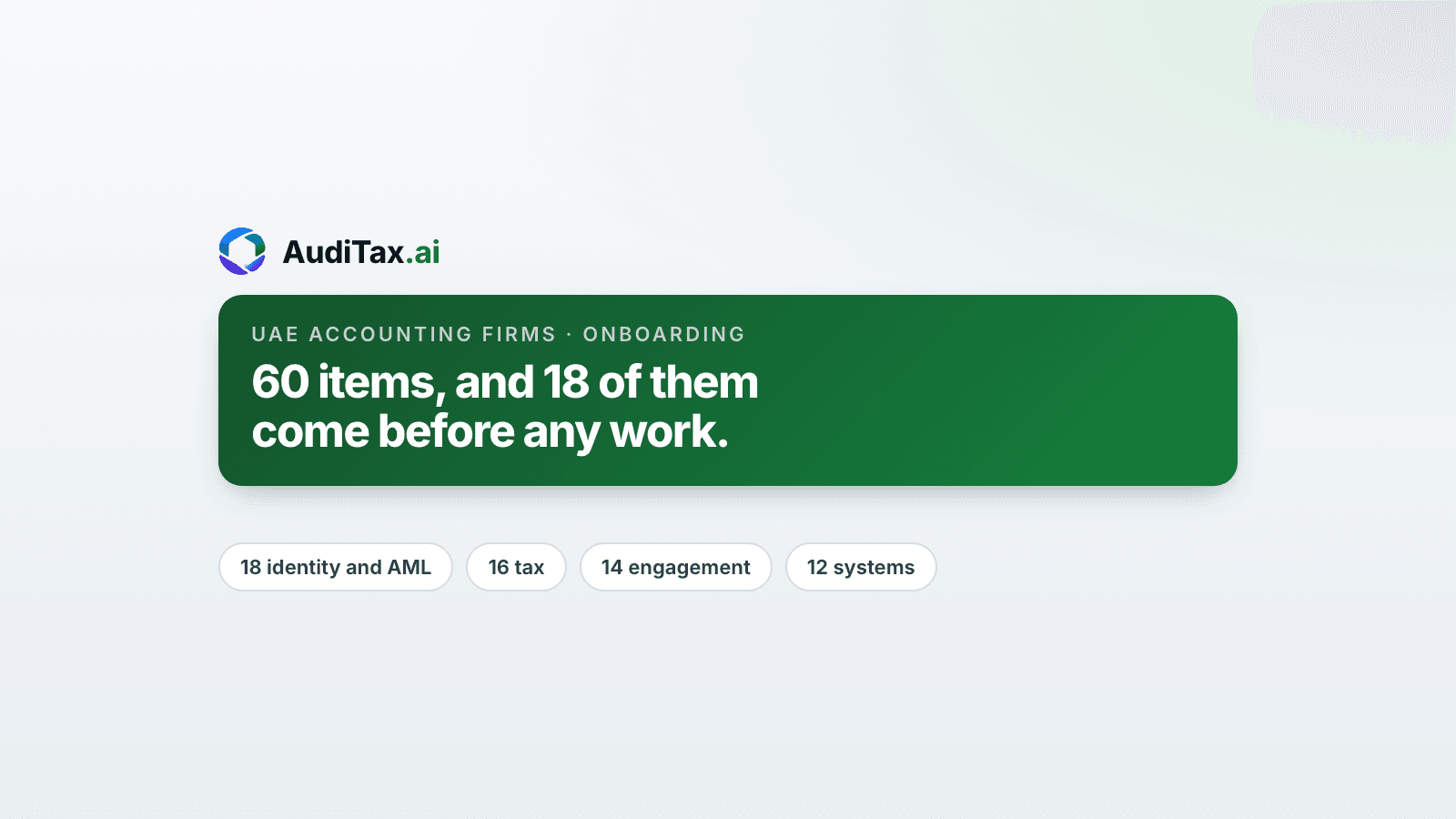
The short answer. Onboarding a UAE client has sixty things in it, and they fall into four groups: identity and anti-money laundering, tax and registrations, engagement and commercials, and systems and handover. Do the first group before you do any work at all, because the law says you may not act without it. Do the rest in the first two weeks, because after that nobody will send you anything.
Onboarding is the only moment you have leverage
A client who wants you to start will send you a passport copy today. The same client, four months in and happy with the service, will not answer three emails about a trade licence renewal date.
That asymmetry is the whole argument for a checklist. Every item below is easy in week one and awkward in month six, and a few of them become impossible: you cannot retrospectively evidence that you verified a client's identity before you acted for them, because the date is the point.
There is also a legal floor underneath it. Your firm is a Designated Non-Financial Business or Profession, supervised for anti-money laundering in its own right, and the Ministry of Economy and Tourism's guidelines prohibit establishing or maintaining a business relationship, or executing any dealing, without completing risk-based customer due diligence, for any reason. Not for a referral, not for a small fee, not because the work is urgent.
One more thing the checklist buys you, which is harder to see. A client who is taken through sixty structured questions in their first fortnight forms a view of the firm, and it is the view you want: that you are organised, that you will not lose things, and that the deadlines will be handled. Firms that onboard loosely spend the next two years rebuilding that impression one apology at a time.
Group one: identity and anti-money laundering
Eighteen items, and this is the group with legal force. None of it is optional and none of it waits until after the first piece of work.
| # | Item | Why it matters |
|---|---|---|
| 1 | Client type recorded: individual or company | The two carry different fields and different risk |
| 2 | Trade licence copy, in date | Also gives you the renewal anniversary for later |
| 3 | Memorandum or articles of association | Establishes who can bind the company |
| 4 | Certificate of incorporation or commercial registration | Confirms the legal person actually exists |
| 5 | Emirates ID of each signatory | Identity of the people you will take instructions from |
| 6 | Passport copy of each signatory | Nationality drives part of the risk assessment |
| 7 | Visa page or entry stamp where relevant | Residency status |
| 8 | Ownership structure, down to the natural persons | Beneficial ownership is the point, not the first layer |
| 9 | Identity documents for every beneficial owner | Verification, not just identification |
| 10 | Source of funds or source of wealth, where risk requires | The question that distinguishes due diligence from filing |
| 11 | Purpose and intended nature of the relationship | A stated requirement, and the basis for noticing later changes |
| 12 | Sanctions screening of the client | UN Security Council consolidated list and the local terrorist list |
| 13 | Sanctions screening of every beneficial owner | The company can be clean while an owner is not |
| 14 | Politically exposed person check on all of the above | Triggers enhanced due diligence if positive |
| 15 | Written risk rating, with the reasons for it | A rating nobody can explain is a rating you cannot defend |
| 16 | Enhanced due diligence completed where the rating demands it | The rating has to change what you actually do |
| 17 | Date of the next scheduled re-screening | Risk ratings go stale; this is the item most often left blank |
| 18 | Who approved taking the client on, and when | Acceptance is a decision, and decisions get recorded |
Item 17 is the one that separates a firm that passes an inspection from one that does not. Collecting documents once is onboarding. Knowing when you will look at them again is a programme.
Group two: tax and registrations
Sixteen items. These are what produce every deadline you will chase for the rest of the relationship, and every one of them is a field with a date in it.
| # | Item | Why it matters |
|---|---|---|
| 19 | Corporate tax registration number, or confirmation it is not yet registered | Registration comes before anything else in that regime |
| 20 | Financial year end | Drives the corporate tax return date, nine months later |
| 21 | First corporate tax period, and whether a return has been filed | Tells you whether you inherited a problem |
| 22 | Whether Small Business Relief has ever been elected | Changes what is in the filed history |
| 23 | Highest revenue the client has ever recorded in a tax period | Small Business Relief eligibility is a once-only test, not an annual one |
| 24 | Value added tax registration number, or the reason there is none | Registration is mandatory above the threshold |
| 25 | The value added tax period the Authority assigned | Assigned, not chosen, so it must be read rather than assumed |
| 26 | Any outstanding value added tax credit balance | Claim windows expire, and a lapsed one cannot be revived |
| 27 | Excise tax registration, if the client deals in excise goods | Easy to miss on a client who does not look like a manufacturer |
| 28 | Gross income in the most recent accounting period | Decides which e-invoicing wave the client is in |
| 29 | Whether an Accredited Service Provider has been appointed | For clients at or above the AED 50 million line, this deadline has passed |
| 30 | Trade licence renewal date | Not a tax date, which is exactly why it gets lost |
| 31 | Establishment card expiry | Same reason |
| 32 | Whether the client is part of a tax group | Changes filing, and changes the e-invoicing scope until 2029 |
| 33 | Free zone status, and whether the client claims Qualifying Free Zone Person treatment | Mutually exclusive with Small Business Relief |
| 34 | Whether an audit is required, and who currently does it | Independence, and your own scope |
Items 23 and 28 are the two most firms do not collect, because neither is a number that appears on a form. Both decide eligibility questions you will be asked about later, and both are far easier to establish at onboarding than to reconstruct.
Group three: engagement and commercials
Fourteen items. This is the group that protects the firm rather than the client, and it is the one partners skip when they are keen to start.
| # | Item | Why it matters |
|---|---|---|
| 35 | Signed engagement letter, before any work | Scope, fee and the limits of your responsibility |
| 36 | Scope written as what is included and what is not | The exclusions are what the letter is for |
| 37 | Fee basis: fixed, hourly, retainer | Decided once, not negotiated monthly |
| 38 | What happens when scope changes | The commonest source of unbilled work |
| 39 | Payment terms and the consequence of late payment | Agreeing it when relations are warm is cheaper |
| 40 | Who at the client may give instructions | Named people, matching the identity documents you hold |
| 41 | Who at the firm owns the relationship | Every deadline needs a person, not a department |
| 42 | Conflict check against the existing client book | Particularly for audit and for related parties |
| 43 | Independence confirmation where assurance work is involved | A professional requirement, not a formality |
| 44 | Professional clearance from the outgoing adviser, where there is one | Courtesy, and an early warning system |
| 45 | Agreed communication channel and response times | Prevents the WhatsApp drift that loses the audit trail |
| 46 | Data protection and confidentiality terms | You are about to hold their identity documents |
| 47 | Termination and handover terms | Write the exit while everyone is friendly |
| 48 | Engagement letter stored against the client record | Findable by someone who was not in the meeting |
Item 44 earns its place twice over. Professional clearance is a courtesy, and it is also the cheapest due diligence available: an outgoing adviser's reluctance to respond tells you something a document never will.
Group four: systems and handover
Twelve items. This is the group that decides whether months two to twenty-four are calm or frantic.
| # | Item | Why it matters |
|---|---|---|
| 49 | Client created on the practice system, not just in email | One record, or the information scatters immediately |
| 50 | Every date from group two entered against that record | Collected and not entered is the same as not collected |
| 51 | Deadlines verified as computed, not typed | A typed date is a date someone has to remember to change |
| 52 | Owner assigned for each recurring obligation | An alert to a shared inbox is not an alert |
| 53 | Access to the client's accounting system, with its own credentials | Never a shared login, and never the client's personal one |
| 54 | EmaraTax access arrangement agreed and documented | Who logs in, and under whose authority |
| 55 | Opening balances agreed in writing with the client | The single most common source of a year-two argument |
| 56 | Prior year filings and workpapers obtained | You inherit the history whether or not you read it |
| 57 | Chart of accounts reviewed against what the client actually does | A chart inherited from a previous bookkeeper rarely fits |
| 58 | Document vault folder created, with the KYC file in it | Retrievable years later, by someone else |
| 59 | First month's work scheduled, with a date | Onboarding ends when work starts, not when the file closes |
| 60 | A thirty-day review booked to catch what was missed | Something is always missed; this is how you find it cheaply |
The five items firms skip, and what each one costs
Across a client book, the same five go missing.
The re-screening date (item 17). Clients onboarded correctly and never looked at again, while sanctions lists changed repeatedly. This is a finding in an inspection, not an oversight.
The highest-ever revenue figure (item 23). Small Business Relief eligibility turns on whether AED 3 million has ever been exceeded, so a field holding this year's revenue cannot answer the question. Firms discover this when a client who crossed the threshold two years ago elects anyway.
Written opening balances (item 55). Agreeing them takes an email at onboarding. Not agreeing them produces an argument in year two about a difference neither side can now explain, usually during a filing week.
The named owner (item 41). Deadlines assigned to the firm rather than to a person are the ones that get missed, because everyone assumes someone else has it.
The thirty-day review (item 60). The cheapest control in the list. Every onboarding misses something; the only question is whether you find it in week four or in month eleven.
A two-week sequence that actually finishes
Sixty items sounds like a project. It is not, if they go in the right order, because most of them are a field rather than a task.
Before you accept the engagement. Items 1 to 18, the conflict check at 42 and the independence confirmation at 43. Nothing here is negotiable and none of it can be done later: the due diligence has to be complete before the relationship is established, and acceptance at item 18 is the decision that closes this stage.
Day one to three. The engagement letter, items 35 to 39 and 46 to 48. Signed before work, because an engagement letter agreed after the first deliverable is a document about the past.
Day three to seven. The registrations, items 19 to 34. This is a reading exercise more than a collection one: most of it comes from EmaraTax, the trade licence and the last set of financial statements, and the client only has to supply what you cannot see.
Day seven to ten. Systems, items 49 to 54 and 58. Create the record first and enter the dates as you confirm them, rather than keeping them in a document and transferring them in a batch that never happens.
Day ten to fourteen. The handover items, 55 to 57, plus professional clearance at 44 if it has come back. Opening balances in writing before you touch the ledger.
Day thirty. Item 60, the review. Fifteen minutes with the record open, looking for blanks.
The sequence matters more than the speed. Doing group one late is a compliance failure; doing group four late is merely expensive.
Applying this to the clients you already have
Most firms reading a checklist like this already have a book, and the honest question is what to do about the two hundred clients onboarded before anyone wrote one down. Doing all sixty items retrospectively for every client is a project nobody finishes.
A sweep in three passes works better, because it front-loads the items with legal consequences.
Pass one, every client, four fields. Is there an identity file, is there a written risk rating, when was the last screening, and who owns the relationship. That is the inspection exposure, and it is four columns in a spreadsheet before it is anything else. Clients with gaps get a date for remediation rather than an apology.
Pass two, every client, the dates. Financial year end, value added tax period, trade licence renewal, and the gross income figure that decides the e-invoicing wave. These are the ones that produce missed deadlines, and they are mostly available to you without asking the client anything.
Pass three, by exception. Everything else, only where it bites: opening balances where there is a known discrepancy, engagement letters where the scope has drifted, professional clearance where you never got it.
Run pass one on your whole book before you run pass two on anybody, because an incomplete identity file is a different category of problem from an unrecorded renewal date. And set the standard for new clients on the day you start the sweep, so the backlog stops growing while you work through it.
When the client pushes back
They will, usually on the beneficial ownership and source of funds items, and usually politely. Three things make the conversation easier.
Say why early, in writing. A sentence in the proposal explaining that your firm is supervised for anti-money laundering and must complete these checks before acting sets the expectation before the client has a reason to feel singled out.
Do not negotiate the floor. The prohibition on acting without completed due diligence has no exception for a good client, and accepting a partial file means the gap is now documented in your own records.
Treat refusal as information. A client who will not explain an ownership layer is telling you about the engagement. That is a decision to record with its reasons, not a problem to work around.
Onboarding a client who is leaving another firm
Most new clients are somebody's old clients, and that changes three items.
Professional clearance (item 44) goes out early, because the response time is not yours to control. Prior filings and workpapers (item 56) matter more than usual, because you are about to sign things that depend on them. And opening balances (item 55) need agreeing in writing before you touch the ledger, not after you find the first discrepancy.
One extra question is worth asking directly: why are they leaving? A client who left over fees will leave you over fees. A client who left because deadlines were missed is telling you what they will measure you on, which is useful, and is also the thing a practice system is for.
Make it a system, not a document
A sixty-item checklist in a shared drive gets copied, edited, and quietly diverges into four versions. The same list as fields on a client record cannot.
The practical difference is in three places. Items you cannot leave blank are completed; items in a document are completed when someone is conscientious. Dates entered as data generate deadlines, while dates written in a form generate nothing. And a record shows its own gaps, so a partner can see which clients are missing a re-screening date without opening sixty files.
This is what AudiTax.ai's client management is built around: one record per client, typed as individual or company so each carries the fields that apply, with the KYC file, documents, deadlines, tasks and invoices all attached to it rather than scattered. The anti-money laundering side of the file, including the risk rating and re-screening as a scheduled task, sits in client KYC and AML. An existing book imports from Excel in bulk, which matters if you are applying this checklist retrospectively to two hundred clients rather than to one.
The deeper version of group one is in the KYC and AML checklist for UAE accounting firms, and the dates that group two produces are laid out across the year in the UAE compliance calendar. Firms looking at the whole practice can start from practice management software for accounting firms.
Sources
- Ministry of Economy and Tourism, Guidelines for Designated Non-Financial Businesses and Professions, March 2026, for the customer due diligence requirements, the prohibition on acting without completing them, sanctions screening against the United Nations Security Council consolidated list and the local terrorist list, the compliance officer's role, and the five-year record retention rule.
- Federal Decree-Law No. 10 of 2025 on anti-money laundering, in force 14 October 2025, and Cabinet Resolution No. 134 of 2025, the Executive Regulations.
- Federal Decree-Law No. 47 of 2022 on the Taxation of Corporations and Businesses, for the corporate tax return deadline of nine months after the end of the tax period.
- Ministerial Decision No. 73 of 2023 as amended by Ministerial Decision No. 131 of 2026, for the Small Business Relief threshold, the once-only nature of the test in Article 2(3), and the exclusion of Qualifying Free Zone Persons in Article 3.
- Ministerial Decision No. 244 of 2025, for the definition of revenue as gross income in the most recent accounting period and the e-invoicing phases, and Ministerial Decision No. 197 of 2026 for the tax-group exclusion running twenty-four months from 1 January 2027.
- Federal Decree-Law No. 28 of 2022 on Tax Procedures, Article 38, for the five-year window on claiming a credit balance and the lapse of the right under Clause 6.
This article states the position as at 6 November 2026. The checklist is a starting point for a UAE practice to adapt, not a substitute for your own compliance officer's judgement or for the current guidance of your supervisory authority.