Missed the 30 September 2026 Corporate Tax Deadline? What to Do Now
Missed the 30 September 2026 corporate tax deadline? Two penalties are running: AED 500 a month rising to AED 1,000, and 14% a year on unpaid tax. What to file, what to pay, what to dispute.
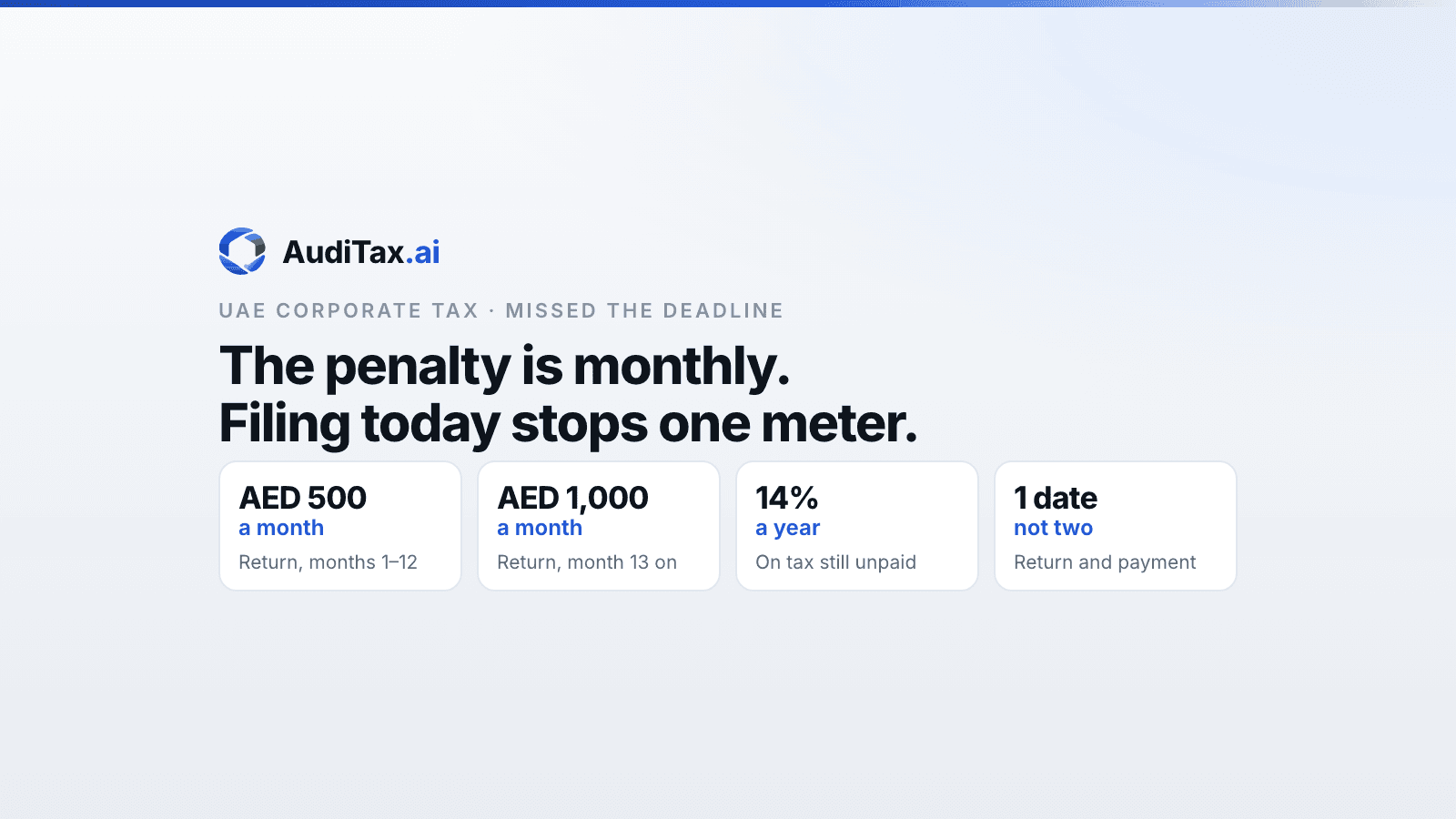
If you missed the 30 September 2026 deadline, two separate meters are now running. The corporate tax late filing penalty in the UAE is AED 500 for each month, or part of a month, for the first twelve months, then AED 1,000 a month from the thirteenth. Separately, tax you have not paid carries 14% a year, charged for each month or part of a month. Filing stops the first meter. Only paying stops the second. The FTA announced no extension and there is no grace period so the cheapest thing you can do today is file, even if you cannot pay in full yet.
Both penalties come from the schedule to Cabinet Decision No. 75 of 2023, as amended by Cabinet Decision No. 10 of 2024. Neither was touched by the penalty reform that came into force in April 2026, which is a point worth coming back to, because a lot of internal penalty schedules were quietly rewritten on the assumption that it was.
Two penalties, not one
The single most expensive misunderstanding here is thinking the deadline was a filing deadline. It was not. Under Article 53 of Federal Decree-Law No. 47 of 2022, the return and the payment are both due nine months after the end of the tax period the same day, not two days. For a financial year that ended 31 December 2025, that day was 30 September 2026.
So one missed date can start two charges:
What was missed | What it costs | How it accrues |
|---|---|---|
Filing the return | AED 500 a month for months 1–12, then AED 1,000 a month from month 13 | For each month or part of a month, from the day after the filing deadline |
Paying the tax | 14% a year on the tax still unsettled | For each month or part of a month, from the day after the payment due date |
Two details in that table do most of the damage.
“Or part of a month” means one day counts as a month. File on 1 October and you owe the same AED 500 as someone who files on 29 October. The second month’s penalty then lands on the same calendar date the month after not at a month end.
The filing penalty does not care whether you owe tax. A company under the AED 375,000 profit threshold, or one that has elected Small Business Relief, still has to file. Nil tax, real penalty: AED 500 a month for a return nobody was waiting on. Small Business Relief in particular is an election claimed on the return skipping the return does not simplify anything, it just makes the relief unclaimed and the penalty live.
What the UAE corporate tax late filing penalty costs, month by month
Here is the arithmetic, with the 14% charge worked on AED 100,000 of unpaid tax so you can scale it. The 14% a year is charged monthly, which works out at about 1.17% of the unpaid tax each month.
Months late | Late filing penalty | 14% charge on AED 100,000 unpaid | Running total |
|---|---|---|---|
1 | AED 500 | AED 1,167 | AED 1,667 |
3 | AED 1,500 | AED 3,500 | AED 5,000 |
6 | AED 3,000 | AED 7,000 | AED 10,000 |
12 | AED 6,000 | AED 14,000 | AED 20,000 |
18 | AED 12,000 | AED 21,000 | AED 33,000 |
24 | AED 18,000 | AED 28,000 | AED 46,000 |
If you owe nothing, read only the second column: AED 6,000 after a year, AED 18,000 after two. The decision states no cap on either charge, so the line keeps going.
The shape of that table is the argument for acting today rather than at the weekend. Month 13 is where the filing penalty doubles, and the 14% is linear but relentless it is the column that gets large on a real tax bill, not the fixed fee everyone talks about.
What to do now, in order
1. File the return today, even if it is not perfect. The filing penalty stops the day the return is submitted, and nothing else you do stops it. A return filed on a best estimate and corrected later through a voluntary disclosure costs far less than a perfect return filed in March. The EmaraTax portal does not close after the deadline.
2. Pay whatever you can, now. The 14% runs on the unsettled balance, so a part payment shrinks the base the charge is calculated on from the next month. There is no benefit to waiting until you can clear it in one go.
3. Check what the FTA has actually raised. Log into EmaraTax and look at the penalties on the account rather than assuming the arithmetic above. Penalties are raised against the record, and the record is where any dispute starts.
4. Fix the numbers properly, not quietly. If the return you just filed has an error in it, that is a voluntary disclosure, not an amendment you make next year. See the next section.
5. Work out whether a dispute is real or wishful. “We did not know” is not a ground. The grounds that exist are narrow and specific, and they are set out below.
6. If the penalty is large and the cash is not there, ask about instalments. This is a formal route with a threshold, not a phone call.
7. Put the next date somewhere that is not a person’s memory. The deadline that caught you this year is a known quantity: it is your financial year end plus nine months. A missed deadline is almost never a knowledge failure.
If the numbers were wrong, not just the date
A voluntary disclosure is how an error in a filed return gets corrected, and the penalty for using it is much smaller than the penalty for being found out.
You disclose it yourself: 1% of the tax difference, for each month or part of a month, from the day after the original return was due until the disclosure is filed.
The FTA notifies you of an audit first: a fixed 15% of the tax difference, plus the same 1% monthly charge.
That 15% is the entire argument for disclosing early. It is a one-off hit that exists purely to make the timing of the disclosure matter, and it attaches the moment an audit notification lands.
If you think the penalty is wrong
There is a sequence, and each step has a clock on it.
Reconsideration. You have 40 business days from being notified of the FTA’s decision to ask it to reconsider. The FTA then has 40 business days to issue its decision and 5 more to tell you. This is the first and cheapest stop.
Objection to the Tax Disputes Resolution Committee. If the reconsideration goes against you, you have 40 business days from that decision to object to the TDRC but the disputed tax and penalties have to be paid before the objection is accepted. The committee issues its decision within 20 business days. That payment condition is what makes the reconsideration stage worth doing well.
Installments and waivers. Cabinet Decision No. 105 of 2021 is the route for penalties you cannot pay or believe should be lifted. An installment request covers unsettled penalties only, needs the penalty to be at least AED 50,000, and is not available while the penalty is before the TDRC. A waiver is narrower still: the grounds are things like the death or serious illness of the taxpayer or a key employee, or restrictions imposed by a UAE government body and it is granted at the FTA’s discretion, never automatically. Penalties tied to a tax evasion case are out of scope entirely.
The penalty this one is not
If what you missed was registration rather than filing, that is a different fine: a one-off AED 10,000, added to the schedule by Cabinet Decision No. 10 of 2024 from 1 March 2024. It also has a relief route the filing penalty does not: file your first corporate tax return or annual declaration within seven months of the end of your first tax period and the AED 10,000 is waived automatically, with no separate application. We covered that one in full in the AED 10,000 late registration penalty.
Worth being clear about the overlap: the seven-month waiver rescues a late registration. It does nothing for a late return in a later year. They are separate rows on the same schedule.
What April 2026 did not change
Cabinet Decision No. 129 of 2025 came into force on 14 April 2026 and rewrote the penalty provisions for the Tax Procedures Law, VAT and excise simplifying them, softening the fines for minor administrative slips, and leaning harder on voluntary disclosure.
Corporate tax was not in it. Corporate tax penalties still sit under Cabinet Decision No. 75 of 2023 as amended. If your firm refreshed its internal penalty schedule after April 2026 and applied the new, gentler numbers across the board, the corporate tax rows in that schedule are wrong, and they are wrong in the direction that gets a client a surprise.
The part a firm can actually control
Nobody misses a nine-month deadline because the rule is hard. They miss it because the date lives in one person’s head, or in a spreadsheet that was accurate for the clients who onboarded in March and silent about the one who onboarded in August.
That is the gap AudiTax.ai’s deadline alerts are built for. Alerts fire as a client’s own deadlines approach and go to the person who owns that work in-app, push and email from one place, rather than a broadcast everybody assumes somebody else is reading. An alert becomes a task with an assignee and an activity log, so “this is due” and “this is done” are the same thread. The dates themselves come from the client’s own record: year end, tax period, licence expiry. If you want the whole picture of which dates are fixed and which move with each client, that is the UAE compliance calendar, and the corporate tax dates alone are in the deadlines every firm should have on the wall.
One thing it explicitly does not do: AudiTax.ai does not file with the FTA on your behalf. Submissions go through EmaraTax. What it removes is the part where a deadline depends on somebody remembering it.
If you are reading this because 30 September went past, the useful question is not what the penalty is. You now know. It is which of your other clients has a year end that makes their deadline the next one.
See how deadline alerts work →
Sources and read dates
Every figure above was verified on 5 October 2026. Where guidance conflicted, the decision text governs.
Late filing penalty (AED 500 a month for months 1–12, AED 1,000 a month from month 13, for each month or part thereof, from the day after the deadline), late payment charge (14% per annum on unsettled payable tax, for each month or part thereof, from the day after the due date), voluntary disclosure penalties (1% monthly; 15% fixed plus 1% monthly where no disclosure is made before an audit notification), record-keeping and deregistration penalties: schedule to Cabinet Decision No. 75 of 2023, as amended by Cabinet Decision No. 10 of 2024 (in force 1 March 2024, which added the AED 10,000 late registration penalty).
Return and payment both due nine months after the end of the tax period: Federal Decree-Law No. 47 of 2022, Article 53.
30 September 2026 as the date for a financial year ended 31 December 2025, and no extension announced: FTA statements reported September 2026.
Reconsideration and objection timelines (40 business days to request reconsideration; FTA decides within 40 business days and notifies within 5; 40 business days to object to the TDRC, with the disputed amounts payable first; TDRC decides within 20 business days): Federal Decree-Law No. 28 of 2022 on Tax Procedures.
Installments and waivers of administrative penalties, including the AED 50,000 threshold and the grounds: Cabinet Decision No. 105 of 2021.
Late registration penalty waiver where the first return or annual declaration is filed within seven months of the end of the first tax period: FTA Corporate Tax Late Registration Penalty Waiver initiative, effective 14 April 2025.
Penalty reform for Tax Procedures, VAT and excise in force 14 April 2026, corporate tax not included: Cabinet Decision No. 129 of 2025.
This post is general information about UAE corporate tax penalties, not tax advice on any particular company’s position.