UAE Corporate Tax Guide 2026: Registration, Returns, Deadlines and Penalties
Nine per cent above AED 375,000, zero below it and a filing date set by your own year end, not the calendar. The whole regime in one place, with what each rule actually costs.
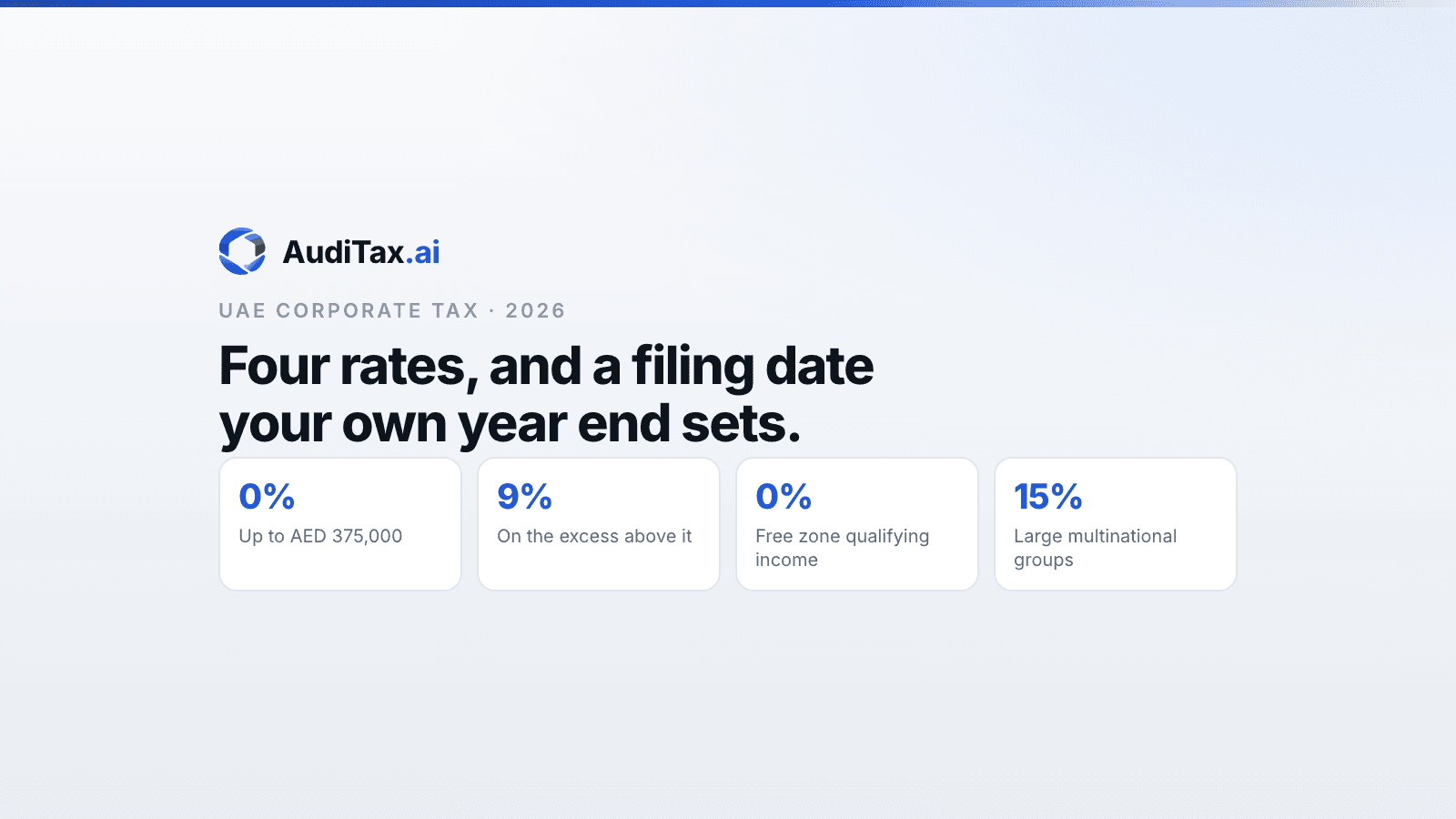
UAE corporate tax is charged at 0% on taxable income up to AED 375,000 and 9% above it, under Federal Decree-Law No. 47 of 2022, for financial years starting on or after 1 June 2023. Registration is compulsory even for a business that will pay nothing. The return and the payment are both due nine months after the end of your own tax period not on a national date so a 31 December year end files by 30 September and a 30 June year end by 31 March. Late registration is AED 10,000, late filing is AED 500 a month rising to AED 1,000, and unpaid tax runs at 14% a year.
Who actually pays it
Corporate tax applies to businesses, not to salaries. A resident juridical person a mainland company, a free zone company, an LLC, a branch is in scope on its worldwide income. A non-resident is in scope on income attributable to a permanent establishment in the UAE or to a nexus here.
Individuals are different. A natural person is only in scope on business or business-like activity, and only once turnover from that activity exceeds AED 1 million in a Gregorian calendar year. Employment income, personal investment income and income from personal real estate investment sit outside the regime entirely.
Some persons are exempt rather than zero-rated government entities, government-controlled entities, qualifying public benefit entities, qualifying investment funds, extractive and non-extractive natural resource businesses, and certain pension and social security funds. Exemption is not automatic for all of them; several must apply and be approved.
The practical version for a firm: if a client holds a trade licence and runs a business, assume they are in scope and work backwards from there, because the cost of assuming the opposite is a registration penalty.
The rate, and the three others people miss
Most coverage stops at "nine per cent". There are four rates in the regime and a practice needs all of them.
Rate | Applies to |
|---|---|
0% | Taxable income up to AED 375,000 |
9% | Taxable income above AED 375,000 |
0% | Qualifying income of a Qualifying Free Zone Person |
15% | Large multinational groups, under the Domestic Minimum Top-up Tax |
The AED 375,000 threshold is per taxable person and applies to the excess only a business with AED 500,000 of taxable income pays 9% on AED 125,000, not on the whole amount.
The 15% rate is the Domestic Minimum Top-up Tax introduced by Cabinet Decision No. 142 of 2024. It applies to constituent entities of multinational groups whose consolidated global revenue was EUR 750 million or more in at least two of the four financial years before the one being tested, for financial years starting on or after 1 January 2025. It is the UAE's implementation of the OECD Pillar Two minimum, and it tops a low-taxed UAE entity up to an effective 15%.
How the tax is calculated
The starting point is the accounting profit in financial statements prepared under IFRS, not a separate tax computation built from scratch. From there you adjust.
The adjustments that matter most in practice:
Unrealised gains and losses treatment depends on the election made over the realisation basis.
Exempt income qualifying dividends from UAE companies, and income under the participation exemption and the foreign permanent establishment exemption.
Non-deductible expenditure fines and penalties, donations to non-qualifying recipients, and a 50% restriction on entertainment expenditure.
Interest a general interest deduction limitation applies above a threshold.
Related-party transactions these have to be at arm's length under the transfer pricing rules, which apply to connected persons as well as group companies.
Tax losses carried forward indefinitely, but offset is capped at 75% of taxable income in any period, subject to continuity-of-ownership conditions.
Only after those adjustments do you apply the 0% and 9% rates. The single most common error in a first return is treating accounting profit as taxable income and filing on it.
Transfer pricing, and when it becomes paperwork
Every transaction with a related party or a connected person has to be priced at arm's length the price unrelated parties would have agreed. This is not a large-group rule. It reaches a founder's salary, a loan from a shareholder, a management fee charged between two companies the same family owns, and rent paid to an owner's own property company. Those are ordinary arrangements in a UAE client book, and they are exactly where a first return goes wrong.
The arm's length requirement applies to everyone. What depends on size is the documentation. Under Ministerial Decision No. 97 of 2023, a taxable person must maintain a master file and a local file where either:
it is a constituent entity of a multinational group with total consolidated group revenue of AED 3.15 billion or more in the tax period; or
its own revenue in the tax period is AED 200 million or more.
Below those thresholds there is no master or local file, but the arm's length standard still binds and the authority can still ask how a price was set. The disclosure form that accompanies the return asks about related-party transactions regardless of size, so "we are too small for transfer pricing" is only ever true about the filing, never about the principle.
Registration: who, when, and the AED 10,000
Every taxable person registers, including one whose income will fall entirely under AED 375,000 and one that expects to pay nothing. Registration is done in EmaraTax and produces a corporate tax registration number the "certificate" clients often ask about is the registration confirmation in that account, not a separate document you apply for.
Federal Tax Authority Decision No. 3 of 2024, effective 1 March 2024, set the deadlines. For a resident juridical person holding a licence issued before 1 March 2024, the deadline ran off the month the licence was issued:
Licence issued in | Register by |
|---|---|
January or February | 31 May 2024 |
March or April | 30 Jun 2024 |
May | 31 Jul 2024 |
June | 31 Aug 2024 |
July | 30 Sep 2024 |
August or September | 31 Oct 2024 |
October or November | 30 Nov 2024 |
December | 31 Dec 2024 |
Where an entity holds more than one licence, the one with the earliest issuance date governs. The year of issue is irrelevant only the month.
For everyone since, the rules are simpler:
Incorporated on or after 1 March 2024 within three months of incorporation, establishment or recognition.
Non-resident with a permanent establishment nine months from the date the establishment existed if that was before 1 March 2024, six months if after.
Natural persons once turnover passes AED 1 million in a Gregorian year, by 31 March of the following year.
Missing the registration deadline is a flat AED 10,000, with no calculation and no grey area. It is covered in full in our note on corporate tax registration and the AED 10,000 penalty.
The first tax period, and the trap inside it
A tax period is the financial year, or the part of it for which a return is required. For a company incorporated under the Commercial Companies Law, the first financial year beginning on or after 1 June 2023 is the first tax period.
That first period does not have to be twelve months. Where the financial year under the Commercial Companies Law runs anywhere from six to eighteen months, the Federal Tax Authority accepts it as the first tax period rather than forcing a split.
Here is the part that costs money. Where the period is not twelve months, the thresholds in the law are not pro-rated. The AED 375,000 band is not scaled down for a seven-month period, and more usefully the AED 3 million revenue threshold for Small Business Relief is not scaled down either. A client with an eighteen-month first period is measured against the same AED 3 million as a client with twelve. It is worth checking before an election is made on an assumption.
The return and the payment: one date, not two
The return and the payment are both due nine months after the end of the tax period. There is no separate, later payment window and there are no provisional instalments. A firm that files on time and pays a fortnight later has paid late.
Because the date comes from each client's own financial year end, a practice does not have one corporate tax deadline. It has as many as it has year ends:
Financial year ends | Return and payment due |
|---|---|
31 Mar 2026 | 31 Dec 2026 |
30 Jun 2026 | 31 Mar 2027 |
30 Sep 2026 | 30 Jun 2027 |
31 Dec 2026 | 30 Sep 2027 |
The full year-end-to-deadline table, every month across the next two years, is in the UAE compliance calendar, and the reason December year ends bunch into a single September crush is set out in the deadlines every firm should have on the wall.
What it costs to get it wrong
Three separate penalties, and they stack rather than replace each other.
What happened | Penalty |
|---|---|
Registered late | AED 10,000, once |
Filed the return late | AED 500 per month or part month for the first 12 months, then AED 1,000 per month or part month from the thirteenth |
Paid late | 14% a year on the unpaid tax, applied monthly |
"Per month or part of a month" is doing real work in that table: one day late is a full month's penalty. A return filed thirteen months late carries AED 7,000 in late filing penalties on its own, before any late payment charge.
The 14% annual rate is newer than most guidance admits. It replaced the old compounding structure on 14 April 2026, when Cabinet Decision No. 129 of 2025 came into force and brought value added tax, excise tax and corporate tax under one penalty framework. If a client is working from a 2025 article, their numbers are wrong.
What to do when a date has already passed including the voluntary disclosure route when the figures rather than the date were wrong is set out in our guide to missing a corporate tax deadline.
The reliefs worth knowing before you file
Small Business Relief. A taxable person with revenue of AED 3 million or less may elect to be treated as having no taxable income for that period. The Ministry of Finance extended it on 7 August 2026 through Ministerial Decision No. 131 to tax periods ending on or before 31 December 2029 three years longer than most published guidance still says. It is an election, it has to be made, and it is not open to a Qualifying Free Zone Person or to a member of a large multinational group.
The free zone 0%. A Qualifying Free Zone Person pays 0% on qualifying income and 9% on everything else. Qualifying income is defined by Cabinet Decision No. 100 of 2023 and covers transactions with other free zone persons who are the beneficial recipient, a defined list of qualifying activities with any person, and qualifying intellectual property income under the OECD nexus approach.
The condition that catches people is the de minimis: non-qualifying revenue must stay below the lower of 5% of total revenue or AED 5 million. Breach it, or fail the substance, transfer pricing or election conditions, and the entity loses Qualifying Free Zone Person status for that tax period and the four that follow five periods in total. "Free zone companies don't pay corporate tax" is the sentence that gets clients into trouble; what actually differs between free zone and mainland goes through it properly.
Tax groups. Two or more UAE resident juridical persons can apply to the Federal Tax Authority to be treated as a single taxable person and file one return. The test is a 95% holding by the parent of share capital, voting rights, profits and net assets and the members must share the same financial year and use the same accounting standards.
It simplifies filing and lets losses be used across the group, and transactions between members fall out of the computation. The costs are worth stating plainly: the members are jointly and severally liable for the group's tax, and an audited financial statements obligation arrives that does not depend on size at all see below.
Two things people assume wrongly
Withholding tax. The UAE's withholding tax rate is 0% on the relevant categories of UAE-sourced income paid to a non-resident who has no permanent establishment or nexus here. There is no withholding tax return to file and nothing to deduct at source. It is a real part of the regime set at zero, not an absence which matters when a foreign counterparty asks for a certificate or a treaty form.
Foreign tax paid abroad. A taxable person who has paid qualifying foreign tax on income that is also taxable here may claim a foreign tax credit against the UAE liability. The credit is capped at the UAE corporate tax due on that same foreign income, and any excess is generally neither refunded nor carried forward so the relief removes double taxation rather than making a loss useful.
Records, and who needs an audit
Records supporting a return must be kept for seven years after the end of the tax period. That is a retrieval problem more than a storage one, and it is the same file an FTA audit would ask for.
Audited financial statements are a separate question, governed by Ministerial Decision No. 84 of 2025, which applies to tax periods starting on or after 1 January 2025:
A taxable person that is not a tax group needs audited financial statements where revenue is AED 50 million or more. The test is revenue not accounting profit, not taxable income.
Every tax group must prepare and maintain audited special purpose financial statements, whatever its consolidated revenue. The AED 50 million threshold that used to apply to groups was removed.
For a non-resident, only revenue derived through a permanent establishment or nexus in the state counts towards the threshold.
The scheduling consequence is that an audit cannot be a September job for a December year end. It has to finish far enough ahead of the filing date that the return is not waiting on it.
What changed in 2026
Four things moved this year, and each one makes older guidance wrong rather than merely dated.
Change | From |
|---|---|
Unified penalty framework, flat 14% a year on unpaid tax, replacing the compounding structure | 14 Apr 2026, Cabinet Decision No. 129 of 2025 |
Small Business Relief extended to periods ending on or before 31 Dec 2029 | Announced 7 Aug 2026, Ministerial Decision No. 131 |
Audited financial statements required of every tax group regardless of revenue | Tax periods from 1 Jan 2025, Ministerial Decision No. 84 of 2025 |
Domestic Minimum Top-up Tax at 15% for large multinational groups | Financial years from 1 Jan 2025, Cabinet Decision No. 142 of 2024 |
Economic substance notifications are worth a line here too, because they still appear on circulated checklists: the regime was ended for financial years ending after 31 December 2022, so there is nothing to file for a current year. The 2019 to 2022 periods remain enforceable.
A corporate tax year, end to end
Put together, a single client's year looks like this.
Register once, on incorporation or within the applicable window.
Keep the records as the year runs seven years, retrievable.
Close the year at the client's own financial year end.
Get the audit done if revenue is AED 50 million or more, or if it is a tax group.
Compute: accounting profit, then the adjustments, then the rates.
Decide the elections Small Business Relief, realisation basis, group membership.
File and pay, both nine months after the year end.
For one client that is a checklist. For forty it is a scheduling problem, because every one of those steps lands on a different date per client and the dates arrive months apart while the work in front of you is whatever is due this week. It is also the reason a growing firm eventually outgrows the spreadsheet it started on.
Corporate tax is also only one of the clocks. The same client generates a value added tax return on a stagger the authority assigned them, a trade licence and establishment card that expire on their own anniversaries, and anti-money-laundering obligations that renew on a rhythm of their own.
Holding all of that per client is what AudiTax.ai's compliance tracker is built for: the corporate tax period end, the value added tax due date and the licence and card expiries live on the client record, the system raises its alerts as each date approaches corporate tax counted forward monthly from the period end, from the third month through to the ninth and each alert becomes a task with an assignee and an activity log. Freeing those hours is also what makes year-round advisory work possible rather than aspirational. Firms looking at the whole picture can start from practice management software for accounting firms.
Sources
Federal Decree-Law No. 47 of 2022 on the Taxation of Corporations and Businesses.
Federal Tax Authority Decision No. 3 of 2024 on specified timeframes for corporate tax registration, effective 1 March 2024.
Cabinet Decision No. 75 of 2023 on administrative penalties relating to the Corporate Tax Law, as amended by Cabinet Decision No. 129 of 2025, in force 14 April 2026.
Ministerial Decision No. 97 of 2023 on transfer pricing documentation requirements.
Federal Tax Authority public clarification on the first tax period.
Cabinet Decision No. 100 of 2023 on qualifying income for a Qualifying Free Zone Person.
Cabinet Decision No. 142 of 2024 introducing the Domestic Minimum Top-up Tax.
Ministerial Decision No. 84 of 2025 on audited financial statements, issued 14 April 2025.
Ministry of Finance, extension of Small Business Relief to 31 December 2029, Ministerial Decision No. 131, announced 7 August 2026.
This article states the position as at 22 October 2026. Confirm a client's own dates and figures in EmaraTax before acting on them.