AML Compliance for UAE Accountants and Auditors: The Complete DNFBP Guide
Accountants and auditors are DNFBPs supervised by the Ministry of Economy and Tourism. The governing law changed in October 2025. Every obligation, the sanctions, and where firms fail.
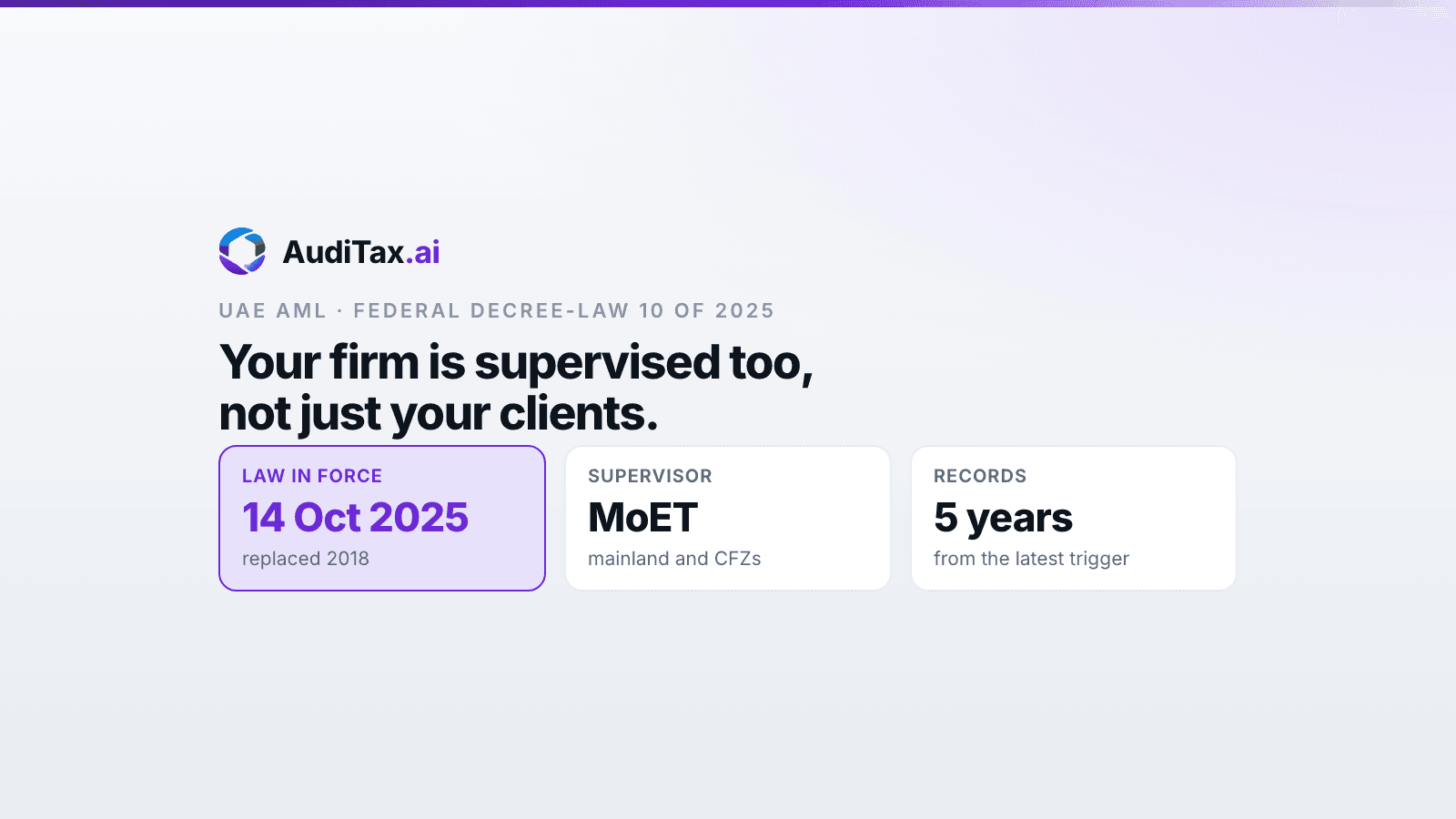
The short answer. An independent accountant or auditor in the UAE is a Designated Non-Financial Business or Profession, supervised for anti-money laundering by the Ministry of Economy and Tourism. That means your firm carries its own obligations, not just your clients': a documented risk assessment, customer due diligence, an approved compliance officer, suspicious transaction reports filed through goAML, sanctions screening and five-year records. The governing law changed on 14 October 2025.
The law you are working to changed in October 2025
This is the first thing to check, because most guidance online still cites the old statute. Federal Decree-Law No. 20 of 2018 has been repealed. Article 41 of Federal Decree-Law No. 10 of 2025 says so in one line, and Article 42 says the new law enters into force two weeks after publication in the Official Gazette. It was issued on 30 September 2025, so it took effect on 14 October 2025.
Three documents now make up the framework a UAE accounting or audit firm actually works to.
| Instrument | What it is | In force |
|---|---|---|
| Federal Decree-Law No. 10 of 2025 | The anti-money laundering, counter-terrorist financing and counter-proliferation financing law. Replaces Federal Decree-Law No. 20 of 2018 | 14 Oct 2025 |
| Cabinet Resolution No. 134 of 2025 | The Executive Regulations made under it. This is where the definition of a DNFBP actually lives | 14 Dec 2025 |
| MoET DNFBP Guidelines, March 2026 | The supervisor's own guidance for the four sectors it supervises, including accountants and auditors | Current |
One transitional point is worth knowing before you throw away a policy manual. Article 41(3) of the new law keeps the regulations, resolutions and circulars issued under the 2018 law in force, but only insofar as they do not conflict with the new law, and only until something supersedes them. So an older procedure is not automatically void. It is also not automatically safe.
The Guidelines are explicit about their own status: they are a practical tool, they do not constitute additional legislation, and where they and the legal framework differ, the legal framework prevails. Treat them as the supervisor telling you how it will read the law, which is worth a great deal, rather than as the law itself.
Are you actually a DNFBP?
Yes, if you are an independent accountant or auditor. The MoET DNFBP Guidelines of March 2026 list the sectors the Ministry supervises, and Independent Accountants and Auditors is one of four:
- Real Estate Agents and Brokers
- Dealers in Precious Metals and Precious Stones
- Independent Accountants and Auditors
- Trust and Corporate Service Providers
Who supervises you depends on where you are licensed, and firms with more than one licence sometimes answer to more than one supervisor.
| Where the firm is licensed | AML supervisor |
|---|---|
| Mainland UAE and commercial free zones | Ministry of Economy and Tourism |
| Dubai International Financial Centre | Dubai Financial Services Authority |
| Abu Dhabi Global Market | Financial Services Regulatory Authority |
| Law firms and legal professionals | Ministry of Justice |
Note what this is not. Being supervised for anti-money laundering is a separate matter from being registered for corporate tax or value added tax, and it is separate again from your audit licence. A firm can be perfectly current with the Federal Tax Authority and entirely delinquent with the Ministry of Economy and Tourism, because nothing connects the two.
The eight obligations, as the supervisor lists them
Section 3.1 of the Guidelines sets out the minimum statutory obligations. They are worth reading in the supervisor's own order, because that order is roughly the order in which a firm should build the programme.
- Identify, understand, manage, assess, document and continuously update money laundering, terrorist financing and proliferation financing risks within your business scope, using a risk-based approach, retaining the risk assessment and providing it to the supervisor on request.
- Define the scope of, and take, necessary due diligence measures.
- Appoint a compliance officer with relevant qualification and expertise, in line with the supervisor's requirements.
- Put in place adequate management and information systems, internal controls, policies and procedures to mitigate risks, and monitor implementation.
- Put in place indicators to identify suspicious transactions.
- Report suspicious activity and cooperate with the competent authorities.
- Promptly apply directives of the Executive Office for Control and Non-Proliferation, or any other competent authority, concerning targeted financial sanctions.
- Maintain adequate and updated records.
Alongside those are four flat prohibitions. You may not maintain a business relationship under an anonymous, fictitious or numbered name. You may not establish or continue a relationship, or execute any dealing, without completing risk-based customer due diligence, for any reason. You may not engage in any capacity with shell banks. And you may not invoke banking, professional or contractual secrecy as a pretext for failing to report.
The risk assessment comes before everything else
This is the obligation firms most often skip, and skipping it makes every later step indefensible. The business-wide risk assessment is what tells you which clients get enhanced due diligence and which get simplified, so a firm without one is applying a risk-based approach with no stated view of its own risk.
The statutory wording is demanding in a specific way: the obligation is to identify, understand, manage, assess, document and continuously update. A risk assessment written once at licensing and never revisited fails the last two verbs. And the Ministry can ask for it, with the supporting information, at any time.
For an accounting or audit practice the honest risk factors are not exotic. They are the client's industry and whether it is cash-intensive, where the beneficial owners are resident, how the engagement was introduced, whether the structure involves offshore vehicles or nominee arrangements, whether anyone connected is a politically exposed person, and what you are actually being asked to do. Forming a company and acting as its registered agent is a different risk profile from preparing a value added tax return.
Customer due diligence, and the one rule with no exceptions
Customer due diligence means identifying the customer and the beneficial owner, verifying those identities from reliable independent sources, understanding the purpose and intended nature of the relationship, and monitoring it on an ongoing basis.
The prohibition in Section 3.2 is the part to underline for every partner in the firm. You may not establish or maintain a business relationship, or execute any business dealing, without completing risk-based customer due diligence, for any reason. Not for a long-standing client, not for a referral from a partner, not because the fee is small, and not because the work is urgent.
In practice the failure is rarely a refusal to do the checks. It is that the checks were done, by somebody, at some point, and nobody can now produce them. A supervisor does not distinguish between due diligence you did not perform and due diligence you cannot evidence.
The compliance officer is an approved appointment, not a job title
This catches more small firms than any other single requirement, because it has a step most people do not expect.
The appointment of your compliance officer, also called the money laundering reporting officer, must receive the prior written approval of your supervisory authority. Naming someone internally is not the same as appointing them. Before that, you must carry out a fit and proper evaluation covering the candidate's AML experience, professional reputation and the absence of criminal or regulatory infractions.
The Guidelines also set out what the role has to be given, and this is where a small practice has to think honestly:
- Appointed at management level, with the authority, independence and resources to do the job.
- Independent of operational and revenue-generating roles such as client onboarding and transaction processing, to the extent practicable.
- Unrestricted access to the data, systems and decision-making forums relevant to the work.
- Executing the duties "under his or her own responsibility", which is the Guidelines' phrase and makes independent judgement a requirement rather than a courtesy.
In a three-partner firm the compliance officer will inevitably also bring in clients. The Guidelines accept that dual roles may be unavoidable and ask for compensating controls instead: clear reporting lines, oversight by senior management, and segregation of duties in high-risk processes. What they do not accept is the conflict going unrecognised and undocumented.
The governance around the compliance officer
Section 7 of the Guidelines puts four more things around the compliance officer, and a small firm cannot quietly drop any of them.
Staff screening and training. You need explicit policies for screening new employees and for training existing ones, and the training has to be continuous rather than annual theatre, because criminal typologies move. Employees must understand the risks the firm actually faces and how the internal controls apply to their own role. Where the firm has foreign branches or subsidiaries, the measures reach those too.
An independent audit function. This one surprises people. Firms are required to establish an effective audit function to assess whether the internal policies, controls and procedures are adequate and are working. It may be internal or external, and smaller firms will usually buy it in, but either way it must be genuinely independent of the compliance and operational functions and free of conflicts of interest. An audit firm cannot have its own partner review the programme they run.
Senior management ownership. The programme is the firm's, not the compliance officer's. Senior management carries responsibility for it, which is also what makes the compliance officer's independence meaningful rather than nominal.
No small-firm exemption. The Guidelines address this directly: differences in size and complexity do not change the obligations, and difficulty in segregating duties does not exempt a firm from them. What a resource-limited firm is expected to do instead is document its policies on customer due diligence, suspicious transaction identification and reporting, and sanctions screening thoroughly, enforce them consistently, review them regularly, and where it departs from them, record an explicit risk-based justification approved by the right person.
That last sentence is the most useful one in the document for a three-person practice. It is an acknowledgement that you will sometimes have one person wearing two hats, paired with a precise statement of what you must produce instead: written policy, consistent application, and a documented reason whenever you deviate.
Reporting: goAML, and the exemption that does not apply to you
Where you have reasonable grounds to suspect that a transaction, attempted transaction or funds relate to a crime, you must report to the Financial Intelligence Unit. The Executive Regulations require reports to go through the electronic system of the Financial Intelligence Unit, which is goAML, and it is the designated compliance officer who makes the report.
The Executive Regulations describe the compliance officer's duty as to "review, scrutinise and study records, receive data concerning Suspicious Transactions, and take decisions to either notify the FIU or maintain the Transaction with the reasons for maintaining while maintaining complete confidentiality." Read that last part carefully: a decision not to report is a decision that has to be recorded with its reasons. An empty reporting log is not evidence of a clean client book. It is an absence of decisions.
Two protections come with reporting, and one trap sits next to them.
You are protected. The firm, its board members, employees and authorised representatives are protected from administrative, civil and criminal liability for reporting in good faith, and that protection holds even if you did not know precisely what the underlying criminal activity was, and regardless of whether any illegal activity actually occurred.
You must not tip off. Neither the firm nor its managers or employees may tell the customer, their representative or any third party, directly or indirectly, that a report is intended or has been made, or disclose anything in it, or that an investigation is under way. The prohibition covers related information given to or requested by the Financial Intelligence Unit, and breaching it carries sanctions.
Now the trap. There is a professional secrecy exemption from the reporting duty, and accountants keep assuming it covers them. It does not. It is available to "lawyers, notaries, other legal professions or independent legal auditors", and only where the information was obtained in the course of assessing a customer's legal position, defending or representing them before courts or in arbitration or mediation, or giving a legal opinion relating to judicial proceedings. The Guidelines then close the door explicitly: there are no exemptions from the statutory reporting requirement provided for other DNFBPs.
If your firm prepares accounts, files returns, audits financial statements or forms companies, you are reporting. Professional secrecy is not a defence, and Section 3.2 lists invoking it as a prohibited act.
Targeted financial sanctions are a separate, faster obligation
Sanctions screening sits apart from the rest of the programme because it has no risk-based gradation and no comfortable timeline. The obligation is to promptly apply the directives of the Executive Office for Control and Non-Proliferation, or any other competent authority, concerning targeted financial sanctions.
That means screening clients and beneficial owners against the United Nations Security Council consolidated list and the UAE's own local terrorist list, freezing without delay where there is a match, and re-screening when the lists change rather than when the client file comes up for review. The sanctions table in the Guidelines prices a failure to freeze without delay at between AED 50,000 and AED 5,000,000, or imprisonment.
Records: five years, but from the latest of five events
The retention period is five years, and the thing people get wrong is what it runs from. It is not five years from the transaction. It is five years from the latest of:
| Trigger | What it means in practice |
|---|---|
| Termination of the business relationship or closure of the account | The clock starts when the client leaves, not when the work was done |
| Completion of an occasional transaction with no business relationship | One-off engagements still generate a five-year file |
| Completion of a supervisory inspection | An inspection restarts the clock on everything it touched |
| Issuance of a final judgment by a competent judicial authority | Litigation extends retention well beyond the engagement |
| Dissolution, liquidation or termination of a legal person or arrangement | A client company winding up does not release the file |
Records must be kept in an orderly way, sufficient to reconstruct transactions so they could support an investigation or be used as evidence, and available to the competent authorities without undue delay. The authorities may also require retention beyond five years for particular customers or categories. A client who left in 2022 after a relationship that began in 2015 therefore has a file you keep until 2027, not one you archived in 2020.
What it costs to get this wrong
The Guidelines reproduce the statutory sanctions. These are criminal penalties under the law, separate from the administrative fines a supervisor can impose.
| Offence | Sanction |
|---|---|
| Money laundering, basic offence | Temporary imprisonment up to 10 years and a fine of AED 100,000 to AED 5,000,000, or either |
| Aggravated money laundering, for example abuse of authority or through an organised crime group | Temporary imprisonment and a fine of AED 300,000 to AED 10,000,000 |
| Financing of terrorism | Life or temporary imprisonment of at least 10 years, and a fine of AED 300,000 to AED 10,000,000 |
| Proliferation financing | Temporary imprisonment and a fine of AED 300,000 to AED 10,000,000 |
| Violating UN Security Council implementation instructions, including failure to freeze without delay | Imprisonment or a fine of AED 50,000 to AED 5,000,000 |
| Violating the Article 15 obligations (internal controls, risk assessment, reporting) intentionally or by gross negligence | Imprisonment and a fine of AED 100,000 to AED 1,000,000, or either |
The last row is the one that applies to an ordinary firm having an ordinary bad year. It does not require anyone to have laundered anything. Gross negligence in your internal controls, your risk assessment or your reporting is enough.
Where firms actually fail
Across this framework, the failures that get found are rarely sophisticated.
The compliance officer was never approved. Someone has the title on an org chart and no prior written approval from the supervisor exists.
The risk assessment is a document, not a process. Written once, never updated, and not actually driving which clients get enhanced due diligence.
Due diligence exists but cannot be produced. Passport copies in an email thread, ownership confirmed verbally, a risk rating nobody can explain the basis for.
Re-screening never happens. Clients onboarded correctly in 2023 and never looked at again, while sanctions lists changed repeatedly.
The reporting log is empty. Not because nothing was ever considered, but because decisions not to report were never recorded with their reasons.
Records were destroyed on the old clock. Files cleared five years after the work rather than five years after the relationship ended.
Every one of those is a record-keeping failure rather than a judgement failure, which is the useful thing about this list: it is fixable with administration rather than expertise. The practical starting point is a client-by-client sweep, and the ground-level version of it is set out in the KYC and AML checklist for UAE accounting firms. The wider discipline of being able to produce a client's file on demand is the same one an inspection tests, covered in audit readiness and client records.
Holding the evidence is what AudiTax.ai's KYC and AML features are for: the identity file, the ownership details, a risk rating you set and can defend, and re-screening that arrives as a task rather than depending on someone's memory, all attached to the client record with an activity trail of who did what and when. It supports your programme and does not replace your firm's own policies or your compliance officer's judgement. Firms looking at the whole practice can start from AudiTax.ai for accounting firms or from practice management software for accounting firms.
Sources
- Federal Decree-Law No. 10 of 2025 regarding Anti-Money Laundering and Combating the Financing of Terrorism and Proliferation Financing, issued 30 September 2025: Article 41 (repeal of Federal Decree-Law No. 20 of 2018 and the transitional saving for existing regulations), Article 42 (entry into force two weeks after publication).
- Cabinet Resolution No. 134 of 2025 regarding the Executive Regulations of Federal Decree-Law No. 10 of 2025, including Article 49 on supervisory guidance and the compliance officer's duties.
- Ministry of Economy and Tourism, Countering Money Laundering, Terrorism Financing and Proliferation Financing: Guidelines for Designated Non-Financial Businesses and Professions, March 2026. Section 1.2 (applicability and the four supervised sectors), Section 2.2 (supervisory authorities), Section 3.1 (minimum statutory obligations), Section 3.2 (prohibitions), Section 3.3 (confidentiality and tipping off), Section 3.4 (protection for reporting persons), Section 5 (sanctions table), Section 7.1 (compliance officer, appointment and prior written approval), Section 10.6 (the professional secrecy exemption and its limits), Section 10.7 (reporting through goAML).
- Federal Decree-Law No. 20 of 2018, cited only as the repealed predecessor.
This article states the position as at 6 November 2026. The framework changed in October and December 2025 and the supervisor's guidance was reissued in March 2026, so confirm the current versions on the Ministry of Economy and Tourism site before relying on a detail. Nothing here is legal advice, and your compliance officer's judgement on any individual client is theirs to make.