UAE E-Invoicing Guide 2026–2027: Timeline, ASPs, PINT-AE and Penalties
The first deadline has passed and the rules changed twice in October. The current timeline, what PINT-AE actually requires, and the penalty regime that replaced the old one.
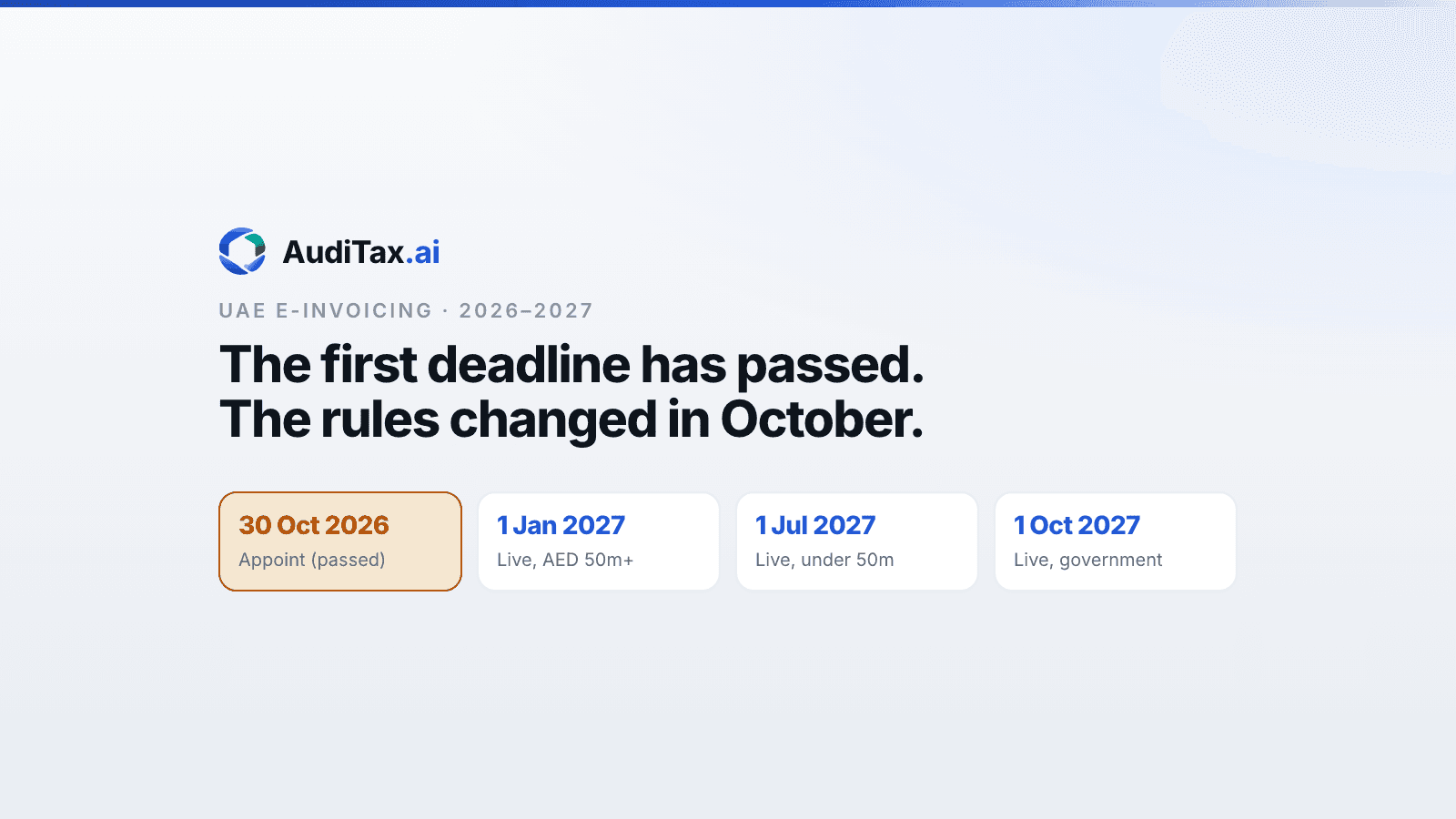
The short answer. UAE e-invoicing goes live for businesses with revenue of AED 50 million or more on 1 January 2027; the deadline for that group to appoint an Accredited Service Provider was 30 October 2026 and has passed. Everyone else appoints by 31 March 2027 and starts on 1 July 2027, with in-scope government entities starting 1 October 2027. Invoices must be issued in the PINT-AE format and exchanged provider-to-provider. Two things changed in October 2026 that most published guidance has not caught: the operating rules were amended by Ministerial Decision No. 197 of 2026, and the penalty regime was replaced by Cabinet Decision No. 173 of 2026.
Where the programme stands today
The first hard date is behind us. Any business at AED 50 million or more that has not appointed a provider is now late, and the penalty is already accruing rather than waiting for January.
The go-live date did not move with it. From 1 January 2027 that same group must be issuing electronically, which leaves roughly eight weeks from today to get from a signed provider agreement to invoices that actually transmit.
| Who | Appoint a provider by | Start issuing |
|---|---|---|
| Voluntary pilot | Not applicable | From 1 Jul 2026 |
| Revenue of AED 50m or more | 30 Oct 2026 (passed) | 1 Jan 2027 |
| Revenue below AED 50m | 31 Mar 2027 | 1 Jul 2027 |
| In-scope government entities | 31 Mar 2027 | 1 Oct 2027 |
Ministerial Decision No. 197 of 2026 amended a number of operating rules in October, but it did not touch these dates. The rollout stands as published.
Who is in scope, and what the test is
The system is built on the value added tax law, Federal Decree-Law No. 8 of 2017, not on a new statute, and the governing instruments are Ministerial Decision No. 243 of 2025 on the scope of the system and Ministerial Decision No. 244 of 2025 on its implementation, both issued on 29 September 2025.
The phase test is revenue, not sector, entity type or free zone status. A client crosses AED 50 million without anything about how the business feels changing, which is why this is answered from the accounts rather than from memory. Where a client sits near the line, the date that applies to them is the question to settle first, because the two phases are five months apart.
The obligation is not only on sellers. A recipient in scope has its own duties in the exchange, which is why "we don't issue many invoices" is not an answer.
What is excluded, and the one exclusion most firms have not noticed
The system applies to persons conducting business in the UAE unless a transaction is excluded. Article 4 of Ministerial Decision No. 243 of 2025 sets the exclusions, and one of them takes a large share of a typical client book out of scope for now.
- Businesses dealing exclusively business-to-consumer are excluded from mandatory implementation until further notice. A pure retail or consumer-services client is, today, outside the mandate.
- Sovereign activities of government entities, where they are not carried on in competition with the private sector.
- International passenger transport by airlines, where an electronic ticket is issued.
- International goods transport by airlines, excluded for 24 months from the system taking effect.
- Financial services that are exempt or zero-rated under the value added tax Executive Regulations.
- Related-party transactions within a value added tax group, treated as excluded for 24 months from 1 January 2027 under Ministerial Decision No. 197 of 2026.
Read the first one carefully, because it is doing more work than it looks. "Exclusively" is the operative word: a client that is mostly retail but issues occasional business invoices is not exclusively business-to-consumer, and the exclusion does not apply to it. The test is the whole of what the business does, not the majority of it.
Two further points. The exclusion is "until further notice", which is not the same as permanently. A client relying on it should be told it is a deferral with no published end date rather than an exemption. And a person whose transactions are excluded may still participate voluntarily, which is occasionally worth doing when their customers are all in scope and want to receive documents the same way.
How it actually works: the five-corner model
The UAE runs a decentralised continuous transaction control and exchange model. In plain terms there are five corners: you, your provider, your customer's provider, your customer, and the Federal Tax Authority.
You do not send an invoice to your customer and separately file something with the authority. You pass a structured document to your Accredited Service Provider; your provider validates it and transmits it to your customer's provider over the exchange network; your customer's provider delivers it; and the tax data is reported to the authority as part of that same movement.
Two consequences fall out of this and both are easy to miss. First, a PDF emailed to a customer is not an e-invoice and never becomes one. Second, your counterparty's readiness affects you, because the document has to be deliverable at the other end.
PINT-AE: the format, and what it demands
PINT-AE is the UAE's national specification of the Peppol International model for billing: the structured XML that says exactly what a UAE electronic invoice contains and how it is built. The Ministry of Finance is the UAE's Peppol Authority: it sets the national requirements, accredits providers, maintains the register and owns the specification.
Three documents matter, and two of them were reissued in the last fortnight:
| Document | Current version |
|---|---|
| UAE Electronic Invoicing Guidelines | v2.0, 26 October 2026 |
| UAE Electronic Invoice Mandatory Field Requirements | v1.1, 28 October 2026 |
| PINT-AE billing specification | Published by Peppol, built on UBL 2.1 |
If a client's implementation was scoped against the February 2026 versions, it was scoped against superseded documents. That is worth one email to whoever is doing the work.
The practical weight of PINT-AE is not the XML, which the provider handles. It is that a structured invoice has defined fields that must be present and must be right, and most client records were never asked for them. A free-text customer name and a trade licence number in a notes field will not satisfy a structured buyer block. This is the part that cannot be fixed in the last week, and it is covered in our guide to getting a firm ready.
What a compliant invoice has to carry
The Ministry of Finance publishes the mandatory field requirements as a separate document from the Guidelines, currently at version 1.1. The XML itself is the provider's problem; the fields are yours, because they come out of your client records.
Broadly the required data falls into four groups:
- The seller: legal name, tax registration number, and a structured address with the emirate resolving to a real one, rather than a single free-text line.
- The buyer: identified properly, with the fields a structured buyer block needs. This is the group that fails most often, because customer records were built for sending a PDF to a person, not for identifying a legal entity to a machine.
- The document: type, a unique identifier, dates, currency, and the reference that links a credit note to the invoice it corrects.
- The lines and the tax: description, quantity, unit price, the value added tax category and rate per line, and totals that reconcile.
The distinction between a field being present and being right is where implementations fail. A tax registration number in the wrong format passes a human eye and fails validation. A buyer identified only by a trading name will not resolve. These are data problems with the client's own records, and the only cheap time to fix them is before the first transmission rather than after a rejection.
One consequence worth planning for: a credit note is itself an electronic document that has to reference the invoice it corrects. A firm used to issuing a corrected PDF and an email apology needs a different habit.
Accredited Service Providers
An Accredited Service Provider is a provider the Ministry of Finance has accredited to transmit electronic invoices and credit notes across the network and report them. Only an accredited provider may offer the service.
Accreditation is not permanent. Under the framework set by Ministerial Decision No. 64 of 2025 and carried forward by Ministerial Decision No. 168 of 2026, accreditation runs in two-year renewable terms with periodic compliance evaluation, and a provider that fails to renew or breaches its conditions can have accreditation revoked and be barred from reapplying for two years.
That matters when choosing one. The register is maintained and published by the Ministry of Finance and it has grown steadily through 2026, so the list to check is the Ministry's own, on the day you check it, not a directory someone compiled earlier in the year.
Questions worth asking a provider that are not on any comparison page:
- How long is onboarding, in practice, for a client of this size? The answer is the number that decides whether 1 January is realistic.
- Which billing systems do you already connect to? An existing connector is weeks of difference against a bespoke integration.
- What happens to invoices that fail validation? You want to see the failure queue before you need it.
- When does accreditation come up for renewal? Two-year terms mean this is a real question, not a theoretical one.
A note worth making plainly, including about our own product: accounting and practice management software is not an Accredited Service Provider. AudiTax.ai is not one. It does not transmit invoices and reports nothing to the Federal Tax Authority on anyone's behalf. Appointing a provider is a separate step, and the specifics of that appointment are set out in our note on the appointment deadline.
What changed in October 2026
Two instruments landed within eleven days of each other, and between them they changed the operating rules and the entire penalty schedule. Most guidance in circulation still describes the position before them.
Ministerial Decision No. 197 of 2026
Announced on 19 October 2026 and effective from 1 October 2026, it amends Ministerial Decision No. 243 of 2025. Four changes matter:
- A transmission window of 14 business days from the date of the business transaction, for electronic invoices and credit notes.
- The requirement to store data inside the UAE is removed. That reopens cloud and provider options that were previously off the table.
- Related-party transactions inside a value added tax group are treated as excluded transactions for 24 months, from 1 January 2027.
- Article 12 is repealed, along with the obligation to notify the Federal Tax Authority of a system failure within two business days.
The rollout dates are untouched.
Cabinet Decision No. 173 of 2026
Announced by the Ministry of Finance on 30 October 2026, it replaces Cabinet Decision No. 106 of 2025, the decision most published penalty tables still cite.
| Element | Position under the new decision |
|---|---|
| Initial violation | AED 5,000 |
| Each month, or part of a month, that it continues | AED 5,000 |
| Maximum in any twelve consecutive months | AED 50,000 |
| Failure to notify the authority of a system failure | Penalty removed |
| One party acting in several capacities | Protected against duplicate penalties for the same violation |
The cap is the headline. Under the previous decision a continuing failure accrued at AED 5,000 a month with no stated ceiling; there is now a limit of AED 50,000 across any twelve consecutive months. That is a meaningful change to a client's worst case, and it cuts the other way too, because a firm quoting the old open-ended exposure to push a client into action is now quoting a number that is no longer right.
Removing the system-failure notification penalty is consistent with Ministerial Decision No. 197 repealing the notification obligation itself. The two decisions were drafted together.
The 14-business-day window, and what it does to a workflow
One of October's changes is easy to read past and hard to implement. Ministerial Decision No. 197 of 2026 sets a transmission window of 14 business days from the date of the business transaction for electronic invoices and credit notes.
That is a clock on the transaction, not on the invoice. A business that raises invoices in a monthly batch (common in services, and in anything billed on a cycle) can be inside its own process and outside the window, because the transaction happened in the first week and the batch goes out in the fifth.
Two practical consequences. Monthly billing runs need checking against the transaction dates they cover, not against the run date. And credit notes inherit the same discipline, which catches firms that treat a correction as something to deal with at month end.
It is also a window a client cannot see for themselves until it is missed, because nothing in an accounting system flags it. That makes it a question to ask during onboarding rather than a setting to configure afterwards.
Your own firm is in scope too
Accounting and tax practices spend this period advising clients and occasionally forget that they are businesses issuing invoices to other businesses. A firm billing corporate clients is making business-to-business supplies, so the exclusion for exclusively consumer-facing businesses does not apply to it.
Which phase the firm itself falls into is the same revenue test everyone else gets. Most practices sit below AED 50 million, which puts them in the second wave: appoint by 31 March 2027, issue from 1 July 2027.
There is an argument for being early that has nothing to do with compliance. A firm that has been through its own implementation has answers about onboarding time, failed validations and billing-system connectors that no vendor briefing provides, and those answers are what a client is actually buying when they ask the firm which provider to use.
What a firm does now, by client segment
Clients at AED 50 million or more who have appointed a provider. The appointment is done; the eight weeks to 1 January are the whole job. Run the field-level data check now, not in December, because every gap is a conversation with the client and those take days each.
Clients at AED 50 million or more who have not appointed. They are late and the penalty is running. Appoint this week. The exposure is capped at AED 50,000 across twelve months, which is a reason to act today rather than a reason to relax, and being late on the appointment does nothing to move the 1 January obligation.
Clients below AED 50 million. The dates are 31 March and 1 July 2027. The temptation is to leave it, and the two arguments against are the same as they were: the data problem is identical at the smaller end and the records are usually messier, and every provider will be onboarding the whole sub-AED 50 million population in the same quarter.
Every client. Confirm which phase they are in from the accounts, and record the provider's name and the date of the agreement against the client file, not "we spoke to someone".
The eight-week checklist
- Confirm the phase from the accounts for every client, and write the date against the client file.
- Confirm the appointment: provider name and agreement date, not an intention. Anyone at AED 50 million or more without one is already accruing penalties.
- Check the exclusions properly. "Exclusively" business-to-consumer means exclusively; one business invoice removes the exclusion.
- Re-scope against the current documents: Guidelines v2.0 and Mandatory Field Requirements v1.1, both reissued in late October.
- Run the field check now, client by client, because every gap is a conversation and those take days.
- Test the 14-business-day window against how the client actually bills, not against when they think they bill.
- Book your own firm's implementation before the sub-AED 50 million rush in early 2027.
The part no appointment solves
A signed provider does not make a single invoice transmittable. A structured invoice carries a seller tax registration number, a structured address, an emirate that resolves to a real one, and buyer fields that a free-text customer record simply does not hold. Those gaps are invisible until an invoice is rejected, and they surface one client at a time.
Finding them while there is still time to go back and ask is what AudiTax.ai's e-invoicing readiness check is for: eleven checks across the firm and the client book, telling you which client each gap sits on. It transmits nothing, because that is the provider's job.
E-invoicing also does not arrive on its own. It sits on value added tax, whose decree-law it was issued under, alongside corporate tax on a completely different clock, the licence and establishment card expiries, and the record-retention obligations an FTA audit tests. All of it lands in one compliance calendar, on a different date for every client.
That is the point at which a practice outgrows the spreadsheet, and the hours it frees are what make year-round advisory work possible. Firms wanting the whole picture can start from practice management software for accounting firms.
Sources
- Ministerial Decision No. 243 of 2025 on the scope of the electronic invoicing system and Ministerial Decision No. 244 of 2025 on its implementation, both issued 29 September 2025.
- Ministerial Decision No. 197 of 2026 amending Ministerial Decision No. 243 of 2025, announced 19 October 2026 and effective 1 October 2026.
- Cabinet Decision No. 173 of 2026 on violations and administrative penalties for the electronic invoicing system, announced by the Ministry of Finance on 30 October 2026, replacing Cabinet Decision No. 106 of 2025.
- Ministerial Decision No. 64 of 2025 on service provider eligibility and accreditation, issued 20 March 2025, and Ministerial Decision No. 168 of 2026.
- Ministry of Finance, UAE Electronic Invoicing Guidelines v2.0, 26 October 2026, and UAE Electronic Invoice Mandatory Field Requirements v1.1, 28 October 2026.
- Ministry of Finance eInvoicing programme pages, including the accredited service provider register.
This article states the position as at 5 November 2026. This area has changed twice in the last month, so confirm the current documents on the Ministry of Finance eInvoicing pages before acting.