UAE VAT Changes 2026: What Actually Changed, and the Law Number Everyone Gets Wrong
The 2026 VAT changes are e-invoicing changes, delivered by three instruments issued this year. The amending laws beneath them are Federal Decree-Law 16 of 2024 and 17 of 2024, not the 2025 number doing the rounds.
The short answer. The UAE VAT changes landing in 2026 are electronic invoicing changes, and they arrive through three instruments issued this year: Ministerial Decision 66 of 2026, which moved the deadline to appoint an accredited service provider to 30 October 2026, Ministerial Decision 197 of 2026, in force from 1 October 2026, and Cabinet Decision 173 of 2026, which replaced the penalty table. The amending laws underneath them are Federal Decree-Law 16 of 2024 and Federal Decree-Law 17 of 2024, both issued on 30 September 2024 and effective from 30 October 2024.
First, the law number everyone gets wrong
A great deal of UAE commentary attributes the 2026 VAT changes to a "Federal Decree-Law 16 of 2025". No such instrument appears in the consolidated texts the Ministry of Finance publishes. The amendments are a year earlier and carry different numbers.
| What it is called | What it actually is |
|---|---|
| Federal Decree-Law 16 of 2025 | Not found in the published VAT or Tax Procedures texts |
| Federal Decree-Law 16 of 2024 | Amends the VAT Law. Issued 30 September 2024, effective 30 October 2024 |
| Federal Decree-Law 17 of 2024 | Amends the Tax Procedures Law. Issued 30 September 2024, effective 30 October 2024 |
This matters more than pedantry. If your firm's memo, training deck or client letter cites an instrument that does not exist, the first reader who checks will stop trusting the rest of it.
What the 2024 amendment put into the VAT Law
Federal Decree-Law 16 of 2024 did four things to Federal Decree-Law 8 of 2017, and the fourth is the one with teeth.
It added three definitions to Article 1. Electronic Invoicing System, defined as an electronic system designated for the issuance, transmission, exchange and sharing of invoice and credit note data. Electronic Invoice and Electronic Credit Note, each defined as a document issued, transmitted and received in a structured electronic format that enables automatic and electronic processing.
It added Clause 5 to Article 65. A registrant subject to the Electronic Invoicing System must issue and transmit tax invoices in the form of an electronic invoice. Not may. Must.
It amended Article 70 on tax credit notes so the same machinery covers credit notes issued by electronic means.
And it added a condition to input tax recovery. Article 55, Clause 1, paragraph (c) now reads that the taxable person must retain the tax invoice in accordance with the Electronic Invoicing System, where it is required to be issued or has been issued in the format of an electronic invoice. Recovery is no longer only about holding a valid invoice. It is about holding it the right way.
What the 2024 amendment put into the Tax Procedures Law
Federal Decree-Law 17 of 2024 is shorter and structural. It added the Electronic Invoicing System definition to Article 1, retitled the chapter on record keeping to cover the system, and inserted a new Article 4 bis: the Minister shall issue the decisions needed to implement the system and determine its effective dates, requirements and provisions, and any person determined by the Minister shall be subject to it.
Article 4 bis is the hook everything else hangs from. Every ministerial decision below is issued under it, which is why the detail lives in decisions rather than in the law.
The three instruments that landed in 2026
| Instrument | What it did | From when |
|---|---|---|
| Ministerial Decision 66 of 2026 | Replaced the appointment deadline for businesses with revenue of AED 50 million or more: an accredited service provider by 30 October 2026, not 31 July 2026 | Day after publication |
| Ministerial Decision 197 of 2026 | Rewrote the exclusions, the issuance window and the storage rule in Ministerial Decision 243 of 2025, and repealed its Article 12 | 1 October 2026 |
| Cabinet Decision 173 of 2026 | Repealed Cabinet Decision 106 of 2025 and replaced the violations and penalties table | Day after publication |
Ministerial Decision 197 of 2026, clause by clause
This is the one your clients will ask about, because it changes who is in scope.
New and amended definitions. The definition of Accredited Service Provider was replaced. Tax Group and Taxable Person were added, both taking their meaning from the VAT Law. The definition of System Failure was deleted outright.
A rewritten Article 4 on exclusions. Excluded business transactions now cover sovereign government transactions not in competition with the private sector; international passenger transport by an airline where an electronic ticket is issued; ancillary services to those passengers where an electronic miscellaneous document is issued; international transport of goods by an airline under an airway bill, but only for twenty four months from the date the system becomes effective; financial services exempt or zero rated under Article 42 of the VAT Executive Regulation; and transactions between members of the same tax group, for twenty four months starting 1 January 2027.
A trap inside the voluntary route. An excluded person may still choose to issue electronic invoices. If they do, the decision and all related e-invoicing decisions apply to them mandatorily, with one exception: the decisions on violations and administrative penalties. Opting in therefore buys the obligations without the fines, which is a materially better deal than most clients assume.
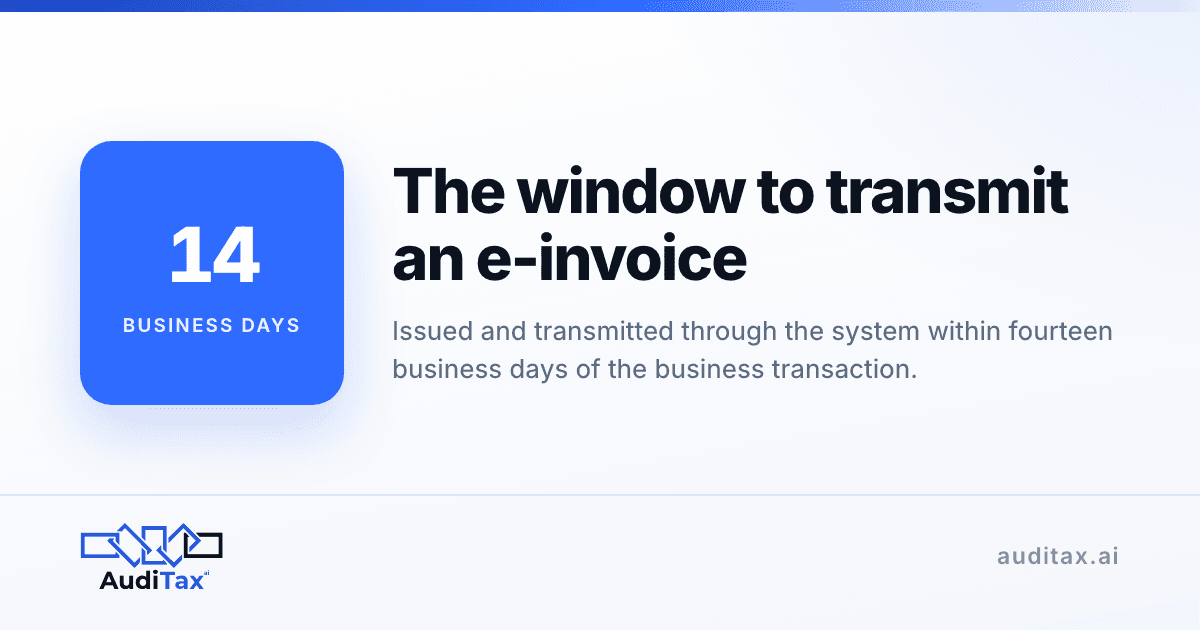
Fourteen business days. The replaced Clause 5 of Article 6 requires the electronic invoice or credit note to be issued and transmitted through the system within fourteen business days from the date of the business transaction.
Storage. The replaced Article 11 requires every person subject to the system to retain all electronic invoices, credit notes and associated data for the period prescribed under the Tax Procedures Law, and to be able to produce them to the Authority on request.
The new penalty table
Cabinet Decision 173 of 2026 repealed the 2025 penalty decision and annexed a shorter table. Note Article 2, which excepts anyone participating voluntarily, and Article 3, which imposes only one penalty where the same person is both issuer and recipient of the same violation.
| Violation | Penalty |
|---|---|
| Failure to implement the system, including failure to appoint an accredited service provider, or a recipient failing to keep up its obligations afterwards | AED 5,000 for the first instance, then AED 5,000 for each month or part of a month that non compliance continues, capped at AED 50,000 in any twelve consecutive months |
| Failure by the issuer to issue and transmit an electronic invoice | AED 100 per invoice, up to AED 5,000 per calendar month |
| Failure by the issuer to issue and transmit an electronic credit note | AED 100 per credit note, up to AED 5,000 per calendar month |
| Failure to notify the accredited service provider of changes to the data registered with the Authority | AED 250 for each day of delay or part of a day, up to AED 5,000 per calendar month |
What your firm should change this quarter
- Fix the citation. Replace every reference to "Decree-Law 16 of 2025" with Federal Decree-Law 16 of 2024 and Federal Decree-Law 17 of 2024.
- Re-screen the client list against the new Article 4. Airlines, financial services and tax groups move, and two of those exclusions expire.
- Diarise the two expiries: airway bill transport twenty four months from the effective date, and intra group transactions twenty four months from 1 January 2027.
- Add the fourteen business day window to your invoicing controls, because it is shorter than most billing cycles.
- Tell clients who opted in voluntarily that the penalty decisions do not apply to them, and get that in writing.
Most of this is a tracking problem rather than a tax problem: which client sits in which phase, which exclusion expires when, and who has appointed a provider. AudiTax.ai for tax advisors keeps those dates on the client record with an owner and a status, so the answer exists before the client asks. The phase dates themselves are set out in our e-invoicing timeline, the wider VAT position in the UAE VAT guide, and the route for fixing an earlier return in the note on voluntary disclosure.
Sources
- Ministry of Finance eInvoicing page, the official index of every e-invoicing instrument.
- Ministerial Decision 197 of 2026, for the exclusions, the fourteen day window and the storage rule.
- Cabinet Decision 173 of 2026, for the annexed penalty table and the repeal.
- Consolidated VAT Law, whose footnotes attribute each change to Federal Decree-Law 16 of 2024.
- Consolidated Tax Procedures Law, showing Article 4 bis added by Federal Decree-Law 17 of 2024.
This article states the position as at 19 November 2026 and reports what the instruments say rather than interpreting them. It is not tax advice.