VAT Return Filing Charges in the UAE: What Firms Charge in 2026
No UAE authority publishes a tariff for VAT return filing, so every figure online is one firm's price list. What you can price against is the work the law defines, and the eight variables that actually move it.
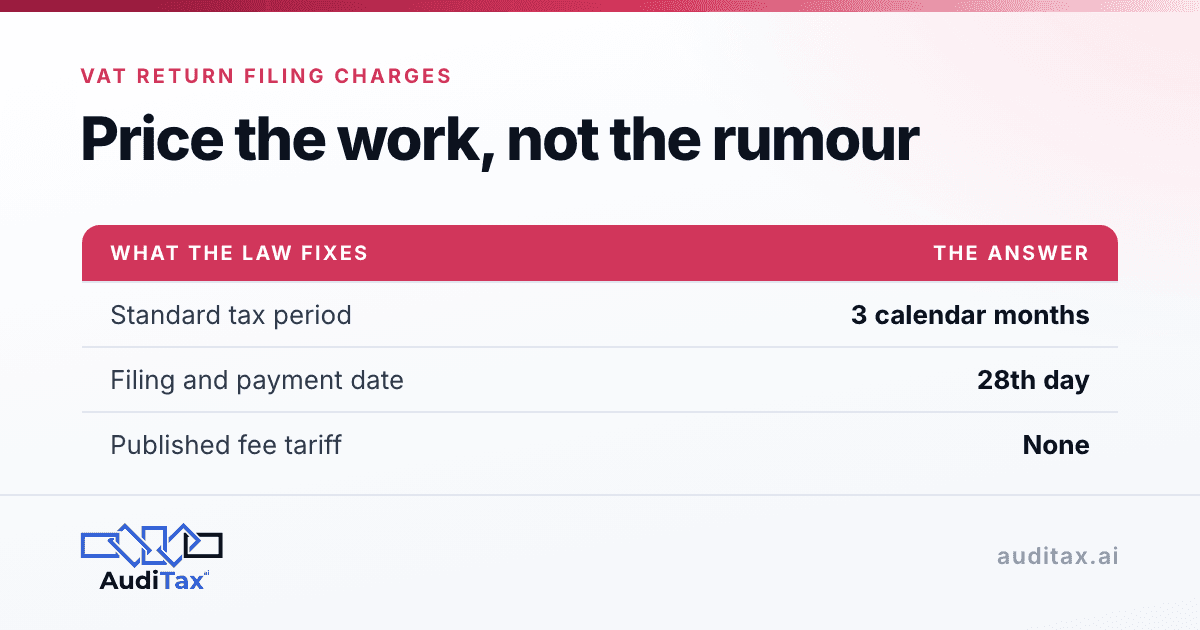
The short answer. No UAE authority publishes a tariff for filing a VAT return, and no neutral benchmark exists, so every figure you find online is one firm's price list rather than a market rate. What you can price against is the work itself, and the law defines that precisely: a return covering a standard three month tax period, carrying ten specified classes of information, received by the Federal Tax Authority no later than the 28th day after the period ends, with the payment landing by the same date.
What the fee actually buys
Article 64 of the VAT Executive Regulation sets out what a return must contain. Read it as a scope of work rather than a form, because each line is a thing somebody in your firm has to establish, evidence and stand behind.
| What the return must contain | What producing it costs you |
|---|---|
| Name, address and Tax Registration Number | Nothing, once. It is the only free line on the form |
| The tax period and the date of submission | Calendar control across every client, which is a system cost rather than a per return cost |
| Value of taxable supplies and the output tax charged | Reconciliation of the sales ledger to the tax ledger, which is where most of the hours go |
| Value of zero rated supplies | Evidence review. A zero rating you cannot support is an assessment waiting to happen |
| Value of exempt supplies | Classification work, and apportionment if the client makes both kinds of supply |
| Value of supplies under Article 48 | Reverse charge identification on imports and on named domestic goods |
| Expenses claimed and the recoverable input tax | The heaviest line: blocked items, partial recovery and the document test on every claim |
| Total due tax, recoverable tax, and the payable or excess figure | Review, sign off and the conversation with the client about the number |
Eight lines of arithmetic, and only two of them are arithmetic. The rest is judgement, and judgement is what you are charging for.
Why no published rate card exists
Three reasons, and all three are permanent.
The Federal Tax Authority regulates tax agents but does not set professional fees, so there is no official tariff to anchor to. The UAE has no mandatory professional body for accountants that publishes a recommended scale. And the firms that do publish prices are usually publishing an entry price for a small client, which is a marketing number rather than an average.
We are not going to invent a range to fill the gap. A made up benchmark would be quoted back at you by a client who found it here, and that is a worse outcome than saying plainly that the number does not exist.
The eight variables that actually move the price
| Variable | Why it moves the fee |
|---|---|
| Transaction volume | The single strongest driver. Fifty invoices and five thousand invoices are not the same engagement |
| Number of tax periods a year | Four for a standard filer, more where the Authority has assigned a shorter period |
| Whether bookkeeping is inside the scope | Filing from a clean ledger is a review. Filing from a shoebox is a bookkeeping job with a return attached |
| Imports and reverse charge | Every import line needs a customs document matched to a return line |
| Mixed supplies | Exempt alongside taxable means apportionment, and apportionment means an annual adjustment too |
| Designated zone activity | Movements in and out of a designated zone change the VAT treatment and the evidence you must hold |
| Quality of the client's records | The variable clients least expect to be charged for, and the one that most often blows the budget |
| History of errors | A client with past corrections needs a tighter review, because the next error is the expensive one |
A monthly filer is not four times a quarterly one
The standard tax period is three calendar months, and the Authority may assign a shorter or longer period where it considers that useful. When a client ends up filing monthly, firms tend to price it as four times the quarterly fee. That overstates it.
The per period work that genuinely repeats is the reconciliation, the review and the submission. The work that does not repeat is the understanding: the client's supply map, the recovery position, the apportionment method. Price the repeating part per period and the standing part per year, and the monthly client stops looking either overpriced or underpriced.
What should sit outside the fee
A filing fee that quietly absorbs everything is how firms lose money on VAT work. Four things belong in a separate engagement, priced separately, agreed before the work starts.
- Voluntary disclosures. Correcting a past return is its own engagement with its own risk, and it should never be free because the error was found during this period's work.
- Federal Tax Authority audits and information requests. Open ended by nature, so price them by time.
- Registration, deregistration and group changes. One off, and unrelated to the filing cycle.
- Catching up the books. If you are reconstructing a year of records, you are not filing a return yet.
Write each of these into the engagement letter as a named exclusion. A client who has read the exclusion rarely argues about the invoice that follows it.
Building a rate card you can defend
Three steps, and the first one is the one firms skip.
Measure what the work takes before you price it. Run time against a sample of returns across your client sizes for one full quarter. You are not guessing at a market rate, you are costing your own delivery, which is the only number you actually control.
Band your clients by the drivers above, not by turnover. Turnover is a poor proxy. A trading company with two large contracts is less work than a retailer with a thousand small ones at the same revenue. Band by volume, complexity and record quality, then set a fee per band.
Define the band in writing, in the engagement. State the transaction volume the fee assumes, name the exclusions, and say what happens when a client crosses into the next band. The point is not to be strict. The point is that the conversation happens at the start, when it is cheap.
Once the bands exist they have to be applied consistently across the practice, which is a record problem rather than a pricing one. Service definitions in AudiTax.ai hold each service with its scope, its inclusions and its fee basis, so the same engagement is priced the same way whoever sets it up. The equivalent exercise for the other half of the compliance calendar is in our note on corporate tax filing charges, and the wider economics of running the practice sit in the guide to starting a UAE firm.
Who carries the penalty
One point worth settling in the engagement letter before it settles itself. Late filing and late payment penalties fall on the taxable person, not on the firm, unless your engagement says otherwise or the delay was yours. Firms that are vague here end up absorbing penalties as a goodwill gesture, which turns a fixed fee into an open liability. The current penalty position is set out in our note on the UAE VAT penalty regime.
Sources
- VAT Executive Regulation, Articles 62 and 64: tax period length, the 28 day deadline, and the contents of a return.
- FTA legislation library, where the consolidated VAT instruments are published.
- FTA tax agent requirements, confirming the Authority registers agents but sets no professional fee scale.
This article states the position as at 19 November 2026. It does not quote a market fee because no neutral UAE benchmark is published, and it is not a recommendation on what to charge.